Development of Indicators for the Use of Good Governance Principles of Educational Institution Administrators Under the Nakhon Si Thammarat Primary Education Service Area Office 1
Article Sidebar
Main Article Content
Abstract
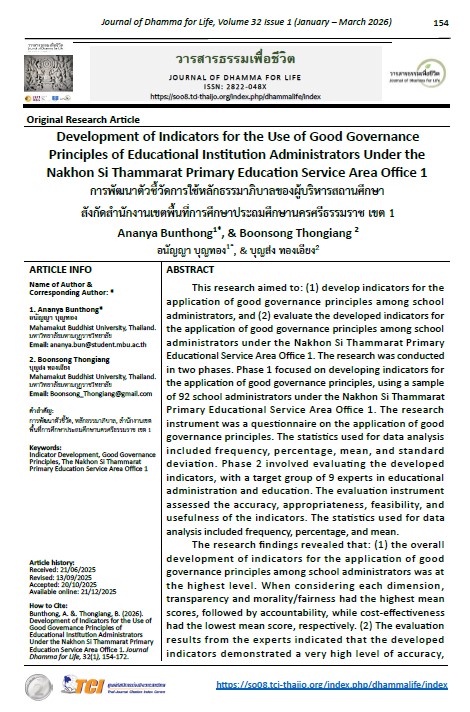
This research aimed to: (1) develop indicators for the application of good governance principles among school administrators, and (2) evaluate the developed indicators for the application of good governance principles among school administrators under the Nakhon Si Thammarat Primary Educational Service Area Office 1. The research was conducted in two phases. Phase 1 focused on developing indicators for the application of good governance principles, using a sample of 92 school administrators under the Nakhon Si Thammarat Primary Educational Service Area Office 1. The research instrument was a questionnaire on the application of good governance principles. The statistics used for data analysis included frequency, percentage, mean, and standard deviation. Phase 2 involved evaluating the developed indicators, with a target group of 9 experts in educational administration and education. The evaluation instrument assessed the accuracy, appropriateness, feasibility, and usefulness of the indicators. The statistics used for data analysis included frequency, percentage, and mean.
The research findings revealed that: (1) the overall development of indicators for the application of good governance principles among school administrators was at the highest level. When considering each dimension, transparency and morality/fairness had the highest mean scores, followed by accountability, while cost-effectiveness had the lowest mean score, respectively. (2) The evaluation results from the experts indicated that the developed indicators demonstrated a very high level of accuracy, appropriateness, feasibility, and usefulness. Overall, the indicators were endorsed at a rate of 99.57 percent, indicating that the developed indicators can be effectively used to assess and enhance the application of good governance principles among school administrators.
Article Details
References
กษาปณ์ โพธิ์สวัสดิ์ และคณะ. (2567). การบริหารตามหลักธรรมาภิบาลของผู้บริหารสถานศึกษาสังกัดสำนักงานเขตพื้นที่การศึกษาประถมศึกษาปทุมธานี เขต 2. วารสารนวัตกรรมสังคมศาสตร์. 1(1), 20 - 36.
เกษม วัฒนชัย. (2554). หลักธรรมาภิบาลกับการบริหารสถานศึกษา. กรุงเทพฯ: มหาวิทยาลัยกรุงเทพ.
ชรินรัตน์ แผงดี. (2562). การพัฒนาระบบการบริหารสถานศึกษาด้วยหลักธรรมาภิบาลสำหรับ ผู้บริหารสถานศึกษา สำนักงานเขตพื้นที่การศึกษามัธยมศึกษา เขต 42. วารสารศึกษาศาสตร์มหาวิทยาลัยนเรศวร, 21(1), 48-59.
ชูศรี วงศ์รัตนะ. (2564). การประเมินผลการเรียนรู้เชิงปริมาณและคุณภาพ. นครศรีธรรมราช: สำนักพิมพ์มหาวิทยาลัยท้องถิ่น.
เชาวรินทร์ ดีฉาย. (2565). การบริหารสถานศึกษาโดยใช้หลักธรรมาภิบาลเป็นฐาน. วารสารบวรสหการศึกษาและมนุษยสังคมศาสตร์, 3(2), 83.
ณภัชกมล สุขมา. (2565). รูปแบบการบริหารสถานศึกษาตามหลักธรรมาภิบาลของโรงเรียนในเขตสำนักงานศึกษาธิการภาค 18 สังกัดสำนักงานคณะกรรมการการศึกษาขั้นพื้นฐาน. ดุษฎีนิพนธ์ปรัชญาดุษฎีบัณฑิต, สาขาวิชาการบริหารการศึกษา, คณะศึกษาศาสตร์, มหาวิทยาลัยบูรพา.
นิกร คำลุม. (2564). การบริหารงานตามหลักธรรมาภิบาลของผู้บริหารสถานศึกษา สังกัดสถาบันการอาชีวศึกษาภาคตะวันออกเฉียงเหนือ 3. วิทยานิพนธ์ศึกษาศาสตรมหาบัณฑิต, สาขาวิชาการบริหารการศึกษา, บัณฑิตวิทยาลัย, มหาวิทยาลัยมหามกุฏราชวิทยาลัย.
ธงชัย สันติวงษ์. (2556). การบริหารสถานศึกษา: ทฤษฎีและแนวปฏิบัติ. กรุงเทพฯ: อักษรศาสตร์.
ล้วน สายยศ และอังคณา สายยศ. (2538). เทคนิควิจัยทางการศึกษา (พิมพ์ครั้งที่ 5). กรุงเทพฯ: สุริยาสาส์น.
สำนักงานคณะกรรมการการศึกษาขั้นพื้นฐาน. (2560). แนวทางการบริหารสถานศึกษาเพื่อพัฒนาคุณภาพผู้เรียน. กรุงเทพฯ: กระทรวงศึกษาธิการ.
สำนักงานคณะกรรมการพัฒนาระบบราชการ (ก.พ.ร.). (2560). แนวทางการบริหารงานภาครัฐตามหลักธรรมาภิบาล. กรุงเทพฯ: สำนักงานคณะกรรมการพัฒนาระบบราชการ.
สำนักงานคณะกรรมการพัฒนาระบบราชการ (ก.พ.ร.). (2562). คู่มือการพัฒนาตัวชี้วัดประสิทธิภาพการบริหารภาครัฐ. กรุงเทพฯ: สำนักงานคณะกรรมการพัฒนาระบบราชการ.
สำนักงานศาลรัฐธรรมนูญ. (2564). รัฐธรรมนูญแห่งราชอาณาจักรไทย พุทธศักราช 2560. (พิมพ์ครั้งที่ 5). กรุงเทพฯ: พี เพรส.
สำนักงานสภาพัฒนาการเศรษฐกิจและสังคมแห่งชาติ สำนักนายกรัฐมนตรี. (2566). แนวนโยบายแห่งรัฐและยุทธศาสตร์ชาติ: การวางกรอบทิศทางการพัฒนาประเทศ. กรุงเทพฯ: สำนักพิมพ์สภาพัฒน์.
สำนักงานเขตพื้นที่การศึกษาประถมศึกษานครศรีธรรมราช เขต 1. (2568). รายงานข้อมูลผู้บริหารสถานศึกษา. นครศรีธรรมราช: สำนักงานเขตพื้นที่การศึกษาประถมศึกษานครศรีธรรมราช เขต 1.
Gall, M. D., Borg, W. R., & Gall, J. P. (1996). Educational research: An introduction (6th ed.). New York: Longman.
Kaplan, R. S., & Norton, D. P. (2001). The strategy-focused organization: How balanced scorecard companies thrive in the new business environment. Boston, MA: Harvard Business School Press.
Krejcie, R. V., & Morgan, D. W. (1970). Determining sample size for research activities. Educational and Psychological Measurement, 30(3), 607–610.
OECD. (2018). OECD principles on effective public governance. Paris: OECD Publishing.
United Nations. (1997). Governance for sustainable human development. United Nations Development Programme (UNDP).
World Bank. (1992). Governance and development. Washington, DC: World Bank.
