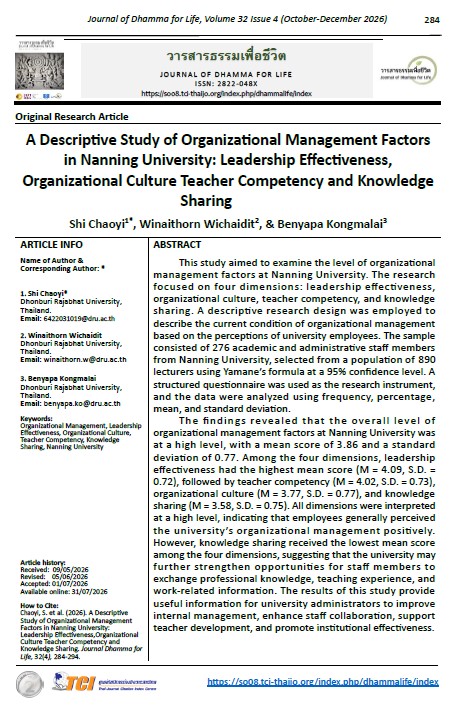
A Descriptive Study of Organizational Management Factors in Nanning University: Leadership Effectiveness, Organizational Culture Teacher Competency and Knowledge Sharing
Article Sidebar
Main Article Content
Abstract
This study aimed to examine the level of organizational management factors at Nanning University. The research focused on four dimensions: leadership effectiveness, organizational culture, teacher competency, and knowledge sharing. A descriptive research design was employed to describe the current condition of organizational management based on the perceptions of university employees. The sample consisted of 276 academic and administrative staff members from Nanning University, selected from a population of 890 lecturers using Yamane’s formula at a 95% confidence level. A structured questionnaire was used as the research instrument, and the data were analyzed using frequency, percentage, mean, and standard deviation.
The findings revealed that the overall level of organizational management factors at Nanning University was at a high level, with a mean score of 3.86 and a standard deviation of 0.77. Among the four dimensions, leadership effectiveness had the highest mean score (M = 4.09, S.D. = 0.72), followed by teacher competency (M = 4.02, S.D. = 0.73), organizational culture (M = 3.77, S.D. = 0.77), and knowledge sharing (M = 3.58, S.D. = 0.75). All dimensions were interpreted at a high level, indicating that employees generally perceived the university’s organizational management positively. However, knowledge sharing received the lowest mean score among the four dimensions, suggesting that the university may further strengthen opportunities for staff members to exchange professional knowledge, teaching experience, and work-related information. The results of this study provide useful information for university administrators to improve internal management, enhance staff collaboration, support teacher development, and promote institutional effectiveness.
Article Details
References
Abdalla, H., & Moussa, A. (2024). Culturally responsive teaching: Navigating models and implementing effective strategies. Acta Pedagogia Asiana, 3(2), 91–100.
Arar, K., Sawalhi, R., & Yilmaz, M. (2022). The research on Islamic-based educational leadership since 1990: An international review of empirical evidence and a future research agenda. Religions, 13(1), 42.
Arif, M., Abd Aziz, M. K. N., & Ma’Arif, M. A. (2025). A Recent Study on Islamic Religious Education Teachers’ Competencies in the Digital Age: A Systematic Literature Review. Journal of Education and Learning (EduLearn), 19(2), 587–596.
Assoratgoon, W., & Kantabutra, S. (2023). Toward a sustainability organizational culture model. Journal of Cleaner Production, 400, 136666.
Banwo, B. O., Khalifa, M., & Seashore Louis, K. (2022). Exploring trust: Culturally responsive and positive school leadership. Journal of Educational Administration, 60(3), 323–339.
Brown, M., Altrichter, H., Shiyan, I., Rodríguez Conde, M. J., McNamara, G., Herzog-Punzenberger, B., Vorobyeva, I., Vangrando, V., Gardezi, S., O’Hara, J., & others. (2022). Challenges and opportunities for culturally responsive leadership in schools: Evidence from four European countries. Policy Futures in Education, 20(5), 580–607.
Channuwong, S., Chaetnaloa, P., Wongwisutthirat, K., Weerachareonchai, P. (2024). Good governance principles in Buddhism for business and politics administration. Migration Letters, 21(S1), 818-827.
Clark, A. M., Zhan, M., Dellinger, J. T., & Semingson, P. L. (2023). Innovating teaching practice through professional learning communities: Determining knowledge sharing and program value. Sage Open, 13(4), 21582440231200983.
Comstock, M., Litke, E., Hill, K. L., & Desimone, L. M. (2023). A culturally responsive disposition: How professional learning and teachers’ beliefs about and self-efficacy for culturally responsive teaching relate to instruction. Aera Open, 9, 23328584221140092.
Deng, C., Gulseren, D., Isola, C., Grocutt, K., & Turner, N. (2023). Transformational leadership effectiveness: An evidence-based primer. Human Resource Development International, 26(5), 627–641.
Fitrianto, I., & Farisi, M. (2025). Integrating local wisdom into 21st century skills: A contextual framework for culturally relevant pedagogy in rural classrooms. International Journal of Post Axial: Futuristic Teaching and Learning, 109–121.
Fonsén, E., Szecsi, T., Kupila, P., Liinamaa, T., Halpern, C., & Repo, M. (2023). Teachers’ pedagogical leadership in early childhood education. Educational Research, 65(1), 1–23.
Haskins, H. E., & Roets, L. (2022). Nurse leadership: Sustaining a culture of safety. Health SA Gesondheid, 27, 2009.
Hava, K., & Babayiğit, Ö. (2025). Exploring the relationship between teachers’ competencies in AI-TPACK and digital proficiency. Education and Information Technologies, 30(3), 3491–3508.
Henshaw, L. A. (2022). Building trauma-informed approaches in higher education. Behavioral Sciences, 12(10), 368.
Huey Jr, S. J., Park, A. L., Galán, C. A., & Wang, C. X. (2023). Culturally responsive cognitive behavioral therapy for ethnically diverse populations. Annual Review of Clinical Psychology, 19, 51–78.
Hyter, Y. D. (2022). Engaging in culturally responsive and globally sustainable practices. International Journal of Speech-Language Pathology, 24(3), 239–247.
Iskamto, D. (2023). Organizational culture and its impact on employee performance. International Journal of Management and Digital Business, 2(1), 47–55.
Jang, S. T., & Alexander, N. A. (2022). Black women principals in American secondary schools: Quantitative evidence of the link between their leadership and student achievement. Educational Administration Quarterly, 58(3), 450–486.
Kessi, A. M. P., Pananrang, A. D., Muchsidin, F. F., Rizal, M., & Ramlah, R. (2025). The role of leadership in effective and efficient human resource management decision making. Paradoks: Jurnal Ilmu Ekonomi, 8(2), 509–524.
Krejcie, R., & Morgan, D. (1970). Sample size determination table. Educational and Psychological Measurement, 30(3), 607–610.
Miller-Cotto, D., Smith, L. V., Wang, A. H., & Ribner, A. D. (2022). Changing the conversation: A culturally responsive perspective on executive functions, minoritized children and their families. Infant and Child Development, 31(1), e2286.
Nadeem, M. (2024). Distributed leadership in educational contexts: A catalyst for school improvement. Social Sciences & Humanities Open, 9, 100835.
Nurhidayat, E., Mujiyanto, J., Yuliasri, I., & Hartono, R. (2024). Technology integration and teachers’ competency in the development of 21st-century learning in EFL classroom. Journal of Education and Learning (EduLearn), 18(2), 342–349.
Oladejo, A. I., Okebukola, P. A., Olateju, T. T., Akinola, V. O., Ebisin, A., & Dansu, T. V. (2022). In search of culturally responsive tools for meaningful learning of chemistry in Africa: We stumbled on the culturo-techno-contextual approach. Journal of Chemical Education, 99(8), 2919–2931.
Olan, F., Arakpogun, E. O., Suklan, J., Nakpodia, F., Damij, N., & Jayawickrama, U. (2022). Artificial intelligence and knowledge sharing: Contributing factors to organizational performance. Journal of Business Research, 145, 605–615.
Scherzinger, L., & Brahm, T. (2023). A systematic review of bilingual education teachers’ competences. Educational Research Review, 39, 100531.
Shiferaw, R. M., Birbirsa, Z. A., & Werke, S. Z. (2023). Entrepreneurial leadership, learning organization and organizational culture relationship: A systematic literature review. Journal of Innovation and Entrepreneurship, 12(1), 38.
Sirathanakul, K., Harnpanich, B., Channuwong, S., Bangbon, P., Niangchaem, L.,
Sutthadaanantaphokin, K. (2023). The influence of human resource management on educational administration of Thai Private Universities. Migration Letters, 20 (S1), 423-436.
Tan, Y., Liu, Y., Long, G., Jiang, J., Lu, Q., & Zhang, C. (2023). Federated learning on non-iid graphs via structural knowledge sharing. Proceedings of the AAAI Conference on Artificial Intelligence, 37(8), 9953–9961.
Van Knippenberg, D., & Hogg, M. A. (2003). A social identity model of leadership effectiveness in organizations. Research in Organizational Behavior, 25, 243–295.
Wang, F., Khodarahmi, N., & Hannah Nguyen, H.-T. (2022). Culturally responsive leadership: A critical review of literature. Handbook of Global Leadership and Followership: Integrating the Best Leadership Theory and Practice, 1–17.
Williams III, J. A., Mallant, C., & Svajda-Hardy, M. (2023). A gap in culturally responsive classroom management coverage? A critical policy analysis of states’ school discipline policies. Educational Policy, 37(5), 1191–1216.
Xia, Z. (2023). Addressing the tasks and opportunities of agency using AI-based Chatbots. International Journal of Communication Networks and Information Security, 15(1), 25–42.
Xu, X., Xia, Z., & others. (2025). Bibliometric analysis on organizational innovation research based on Scopus from 2012 to 2024. Iberoamerican Journal of Science Measurement and Communication, 5(1), 1–19.
