The Model of Strategic Human Resource Management and Employee Organizational Commitment Affecting Modern Organizational Efficiency in Bangkok
Article Sidebar
Main Article Content
Abstract
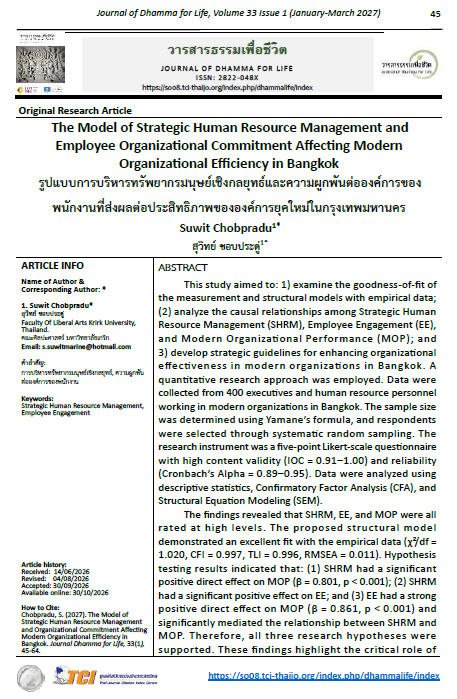
This study aimed to: 1) examine the goodness-of-fit of the measurement and structural models with empirical data; (2) analyze the causal relationships among Strategic Human Resource Management (SHRM), Employee Engagement (EE), and Modern Organizational Performance (MOP); and 3) develop strategic guidelines for enhancing organizational effectiveness in modern organizations in Bangkok. A quantitative research approach was employed. Data were collected from 400 executives and human resource personnel working in modern organizations in Bangkok. The sample size was determined using Yamane’s formula, and respondents were selected through systematic random sampling. The research instrument was a five-point Likert-scale questionnaire with high content validity (IOC = 0.91–1.00) and reliability (Cronbach’s Alpha = 0.89–0.95). Data were analyzed using descriptive statistics, Confirmatory Factor Analysis (CFA), and Structural Equation Modeling (SEM).
The findings revealed that SHRM, EE, and MOP were all rated at high levels. The proposed structural model demonstrated an excellent fit with the empirical data (χ²/df = 1.020, CFI = 0.997, TLI = 0.996, RMSEA = 0.011). Hypothesis testing results indicated that: (1) SHRM had a significant positive direct effect on MOP (β = 0.801, p < 0.001); (2) SHRM had a significant positive effect on EE; and (3) EE had a strong positive direct effect on MOP (β = 0.861, p < 0.001) and significantly mediated the relationship between SHRM and MOP. Therefore, all three research hypotheses were supported. These findings highlight the critical role of employee engagement as a mechanism linking strategic human resource management practices to organizational outcomes. Furthermore, data-driven performance measurement, organizational pride, and organizational learning and growth emerged as the strongest indicators of SHRM, EE, and MOP, respectively. This study contributes to the advancement of Human Capital Theory and Employee Engagement Theory by proposing the “System–People–Performance Framework” to explain how strategic human resource management creates organizational value in the digital economy. The findings also provide practical and policy implications for developing high-performance organizations and achieving long-term organizational sustainability.
Article Details
References
นฤมล พิพัฒน์วงศ์. (2566). การเปลี่ยนแปลงของโครงสร้างตลาดแรงงานในประเทศไทย: ผลกระทบต่อการบริหารทรัพยากรมนุษย์. วารสารเศรษฐศาสตร์และบริหารธุรกิจ, 28(2), 55–74.
พรเทพ ศรีวิโรจน์. (2565). กลยุทธ์การบริหารทรัพยากรมนุษย์ในองค์กรยุคดิจิทัล. กรุงเทพฯ: สำนักพิมพ์มหาวิทยาลัยธรรมศาสตร์.
สำนักงานสถิติแห่งชาติ. (2567). สถิติอุตสาหกรรมและสถานประกอบการในประเทศไทย พ.ศ. 2566. กรุงเทพฯ: สำนักงานสถิติแห่งชาติ.
Bangbon, P., Channuwong, S., Amponstira, F., Rungsuk, A. & Snongtaweeporn, T. (2023). The
influence of transformational leadership on organizational sustainability: A case study of business companies in Bangkok. Journal of Namibian Studies, 33, 4077-4095. https://doi.org/10.59670/jns.v33i.2012
Barney, J. (1991). Firm resources and sustained competitive advantage. Journal of Management, 17(1), 99–120.
Barney, J. B. (1991). Firm resources and sustained competitive advantage. Journal of Management, 17(1), 99–120.
Becker, G. S. (1993). Human capital: A theoretical and empirical analysis, with special reference to education (3rd ed.). University of Chicago Press.
Boselie, P., & van der Heijden, B. (2024). Strategic human resource management: A balanced approach. McGraw-Hill.
Boxall, P. and Purcell, J. (2016). Strategy and Human Resource Management. 4th Edition, Palgrave Macmillan, London.
Boxall, P., & Purcell, J. (2022). Strategy and human resource management (5th ed.). Oxford University Press.
Channuwong, S., Tongvijit, M., Photchanachan, S., Sun, R., & Jia, Y. (2026). Causal
relationships among the factors influencing the competitive capability of Thai real
estate companies based on the concept of sustainable cities and communities (UN
SDG 11). Acta Innovations, 60, 81-95. https://doi.org/10.62441/actainnovations.v60i.684
Channuwong, S., & Kantatian, W. (2012). Stress management strategies for managers: An
integration of Eastern and Western approaches. European Journal of Social Sciences,
29(1), 66-75.
Channuwong, S., Snongtaweeporn, T., Chantarotron, N., Katangchol,S., Ladnongkun, V.,
Kongyoungyune, R., & Damrongsiri, T. (2022). Organizational factors affecting mission
implementation of Thai Private University Personnel. Journal of Positive School
Psychology, 6(8), 5403-5416.
Collings, D. G., McMackin, J., & Nyberg, A. J. (2021). Strategic human resource management and organizational performance: The role of HR capabilities. Journal of Management Studies, 58(6), 1378-1402.
Da Silva, L. B. P., Soltovski, R., Pontes, J., & Treinta, F. (2022). Human resources management 4.0: Literature review and trends. Computers & Industrial Engineering, 163, 107–123. https://doi.org/10.1016/j.cie.2022.107123
Huselid, M. A. (1995). The impact of human resource management practices on turnover, productivity, and corporate financial performance. Academy of Management Journal, 38(3), 635–672.
Kahn, W. A. (1990). Psychological conditions of personal engagement and disengagement at work. Academy of Management Journal, 33(4), 692–724.
Kaplan, R. S., & Norton, D. P. (1996). The balanced scorecard: Translating strategy into action. Harvard Business School Press.
Kaplan, R. S., & Norton, D. P. (2023). Linking the balanced scorecard to strategy. California Management Review, 60(2), 53-79. https://doi.org/10.2307/44225668
Kenikasahmanworakhun, P., Jinain, P., Khantanapha, N., Thanathanchuchot, T.,
Thanathanchuchot, T., Channuwong, S. (2025). Intellectual capital, innovation capability
and knowledge integration of Hi-Tech Firms in Thailand. Journal of Neonatal Surgery,
14(7), 258-265. https://doi.org/10.52783/jns.v14.2394
Kline, R. B. (2016). Principles and practice of structural equation modeling (4th ed.). Guilford Press.
Li, Z., Cheng, J., & Chen, Q. (2022). How does strategic human resource management impact employee voice and innovation? Frontiers in Psychology, 13, 899506.
Li, Y., Huang, Z., & Song, X. (2022). How does strategic human resource management impact employee innovation? The mediating role of psychological mechanisms. Frontiers in Psychology, 13, 904315.
Macey, W. H., & Schneider, B. (2008). The meaning of employee engagement. Industrial and Organizational Psychology, 1(1), 3–30.
OECD. (2022). Investing in human capital for a competitive economy. OECD Publishing.
Richard, P. J., Devinney, T. M., Yip, G. S., & Johnson, G. (2009). Measuring organizational performance: Towards methodological best practice. Journal of Management, 35(3), 718–804.
Rotea, C. C., & Petcu, M. (2023). The link between HRM practices and performance in European firms: Evidence from SEM. International Journal of Environmental Research and Public Health, 20(9), 5672.
Saks, A. M. (2006). Antecedents and consequences of employee engagement. Journal of Managerial Psychology, 21(7), 600–619.
Schaufeli, W. B., & Bakker, A. B. (2004). Job demands, job resources, and their relationship with burnout and engagement. Journal of Organizational Behavior, 25(3), 293–315.
Schultz, T. W. (1961). Investment in human capital. The American Economic Review, 51(1), 1–17.
Teece, D. J., Pisano, G., & Shuen, A. (1997). Dynamic capabilities and strategic management. Strategic Management Journal, 18(7), 509–533.
Ulrich, D., & Dulebohn, J. H. (2015). Are we there yet? What’s next for HR? Human Resource Management Review, 25(2), 188–204.
Wilton, N. (2022). An introduction to human resource management. Sage Publications.
Yamane, T. (1967). Statistics: An introductory analysis (2nd ed.). Harper & Row.