Desirable Characteristics of Administrators of Special Education Centers Under the Special Education Bureau, Group 1 -
Article Sidebar
Main Article Content
Abstract
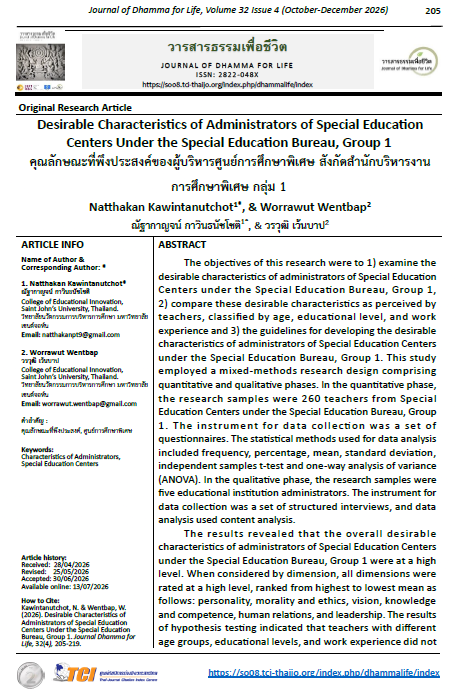
The objectives of this research were to 1) examine the desirable characteristics of administrators of Special Education Centers under the Special Education Bureau, Group 1, 2) compare these desirable characteristics as perceived by teachers, classified by age, educational level, and work experience and 3) the guidelines for developing the desirable characteristics of administrators of Special Education Centers under the Special Education Bureau, Group 1. This study employed a mixed-methods research design comprising quantitative and qualitative phases. In the quantitative phase, the research samples were 260 teachers from Special Education Centers under the Special Education Bureau, Group 1. The instrument for data collection was a set of questionnaires. The statistical methods used for data analysis included frequency, percentage, mean, standard deviation, independent samples t-test and one-way analysis of variance (ANOVA). In the qualitative phase, the research samples were five educational institution administrators. The instrument for data collection was a set of structured interviews, and data analysis used content analysis.
The results revealed that the overall desirable characteristics of administrators of Special Education Centers under the Special Education Bureau, Group 1 were at a high level. When considered by dimension, all dimensions were rated at a high level, ranked from highest to lowest mean as follows: personality, morality and ethics, vision, knowledge and competence, human relations, and leadership. The results of hypothesis testing indicated that teachers with different age groups, educational levels, and work experience did not exhibit statistically significant differences in their perceptions of the desirable characteristics of administrators of Special Education Centers under the Special Education Bureau, Group 1. Guidelines for developing the desirable characteristics of administrators of Special Education Centers under the Office of Special Education Administration, Group 1 consist of six aspects: knowledge and competence, leadership, human relations, personality, morality and ethics, and vision.
Article Details
References
กระทรวงศึกษาธิการ. (2546). กฎกระทรวงกำหนดหลักเกณฑ์และวิธีการกระจายอำนาจการบริหารและการจัดการศึกษา พ.ศ. 2546. ราชกิจจานุเบกษา.
ศรัญญา โนนคู่เขตโขง. (2563). คุณลักษณะของผู้บริหารสถานศึกษาที่ส่งผลต่อประสิทธิภาพการบริหารสถานศึกษา. (รายละเอียดแหล่งพิมพ์ควรตรวจสอบจากต้นฉบับ).
ศูนย์การศึกษาพิเศษ ส่วนกลาง. (2567). รายงานการประเมินตนเองของสถานศึกษา (Self-Assessment Report: SAR) ปีการศึกษา 2567. กรุงเทพฯ: ศูนย์การศึกษาพิเศษ ส่วนกลาง.
สำนักงานเลขาธิการสภาการศึกษา. (2560). แผนการศึกษาแห่งชาติ พ.ศ. 2560–2579. กรุงเทพฯ: สำนักงานเลขาธิการสภาการศึกษา กระทรวงศึกษาธิการ.
สายัณห์ แจ๊ดทอง, & ภาวิดา ธาราศรีสุทธิ. (2564). คุณลักษณะที่พึงประสงค์ของผู้บริหารศูนย์พัฒนาเด็กเล็กในจังหวัดพัทลุง. วารสารวิชาการครุศาสตร์อุตสาหกรรม, 10(1), 15–26.
สิรพงศ์ พงศ์เชื้อทอง, & พงษ์ศักดิ์ รวมชมรัตน์. (2565). คุณลักษณะที่พึงประสงค์ของผู้บริหารสถานศึกษา. วารสารนวัตกรรมการจัดการศึกษาและการวิจัย, 5(1), 13–24.
สมพงษ์ จิตระดับ. (2559). ภาวะผู้นำทางการศึกษาในยุคประชาคมอาเซียน. วารสารศึกษาศาสตร์, 18(2), 10–22.
สุภาวดี สการันต์, และคณะ. (2567). คุณลักษณะที่พึงประสงค์ของผู้บริหารสถานศึกษาในศตวรรษที่ 21. วารสารการบริหารภาครัฐและเอกชน, 6(2), 315–328.
ณัฐวงศ์ อิ้มพัฒน์. (2565). คุณลักษณะอันพึงประสงค์ของผู้บริหารที่ส่งผลต่อประสิทธิผลโรงเรียนการศึกษาสงเคราะห์ สังกัดสำนักบริหารงานการศึกษาพิเศษ ภาคตะวันออกเฉียงเหนือ (วิทยานิพนธ์ครุศาสตรมหาบัณฑิต). มหาวิทยาลัยราชภัฏสกลนคร.
ปัญญา บัวบาน. (2565). คุณลักษณะที่พึงประสงค์ของผู้บริหารสถานศึกษาตามทัศนะของครู กลุ่มสหวิทยาเขตชลบุรี 1 สังกัดสำนักงานเขตพื้นที่การศึกษามัธยมศึกษาชลบุรี (วิทยานิพนธ์ศึกษาศาสตรมหาบัณฑิต). มหาวิทยาลัยบูรพา.
พัชราพร วงศ์ตาขี่. (2565). คุณลักษณะที่พึงประสงค์ของผู้บริหารสถานศึกษา สังกัดองค์กรปกครองส่วนท้องถิ่น อำเภอสูงเนิน จังหวัดนครราชสีมา (วิทยานิพนธ์มหาบัณฑิต). มหาวิทยาลัยราชภัฏนครราชสีมา.
รัตนาภรณ์ กังสันเทียะ, วสันต์ชัย กากแก้ว, & พนา จินดาศรี. (2566). ประสิทธิผลการบริหารศูนย์การศึกษาพิเศษ เครือข่ายส่งเสริมประสิทธิภาพการจัดการศึกษา กลุ่มเครือข่ายที่ 11. วารสารมนุษยศาสตร์และสังคมศาสตร์ มหาวิทยาลัยราชภัฏสุรินทร์, 25(1), 129–143.
วีณา โคตรคำภา. (2566). คุณลักษณะที่พึงประสงค์ของผู้บริหารศูนย์พัฒนาเด็กเล็ก (วิทยานิพนธ์มหาบัณฑิต). มหาวิทยาลัยเซนต์จอห์น.
อรอนงค์ เทียบอุดม. (2565). คุณลักษณะอันพึงประสงค์ของผู้บริหาร (วิทยานิพนธ์มหาบัณฑิต). มหาวิทยาลัยราชภัฏสกลนคร.
Bush, T. (2008). Leadership and management development in education. London: SAGE.
Friend, M., & Bursuck, W. D. (2019). Including students with special needs (8th ed.). Boston, MA: Pearson.
Fullan, M. (2001). Leading in a culture of change. San Francisco, CA: Jossey-Bass.
Glickman, C. D., Gordon, S. P., & Ross-Gordon, J. M. (2004). Supervision and instructional leadership (6th ed.). Boston, MA: Allyn & Bacon.
Hoy, W. K., & Miskel, C. G. (2001). Educational administration (6th ed.). New York, NY: McGraw-Hill.
Hoy, W. K., & Miskel, C. G. (2008). Educational administration (8th ed.). Boston, MA: McGraw-Hill.
Krejcie, R. V., & Morgan, D. W. (1970). Determining sample size for research activities. Educational and Psychological Measurement, 30(3), 607–610.
Leithwood, K., Day, C., Sammons, P., Harris, A., & Hopkins, D. (2004). How leadership influences student learning. New York, NY: The Wallace Foundation.
Mitchell, D. (2015). What really works in special and inclusive education (2nd ed.). London: Routledge.
Sergiovanni, T. J. (2001). The principalship (4th ed.). Boston, MA: Allyn & Bacon.
Stogdill, R. M. (1981). Handbook of leadership. New York, NY: Free Press.
UNESCO. (2020). Global education monitoring report 2020. Paris: UNESCO.
