The relationship between job satisfaction of personnel and the learning organization characteristics of Phichai School, Uttaradit Province
Article Sidebar
Main Article Content
Abstract
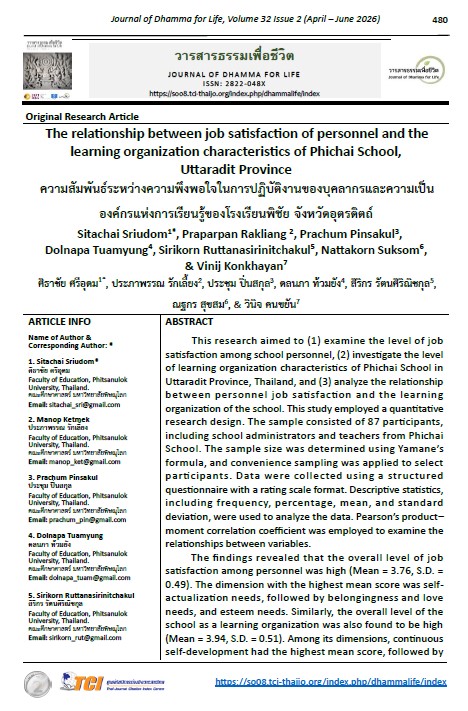
This research aimed to (1) examine the level of job satisfaction among school personnel, (2) investigate the level of learning organization characteristics of Phichai School in Uttaradit Province, Thailand, and (3) analyze the relationship between personnel job satisfaction and the learning organization of the school. This study employed a quantitative research design. The sample consisted of 87 participants, including school administrators and teachers from Phichai School. The sample size was determined using Yamane’s formula, and convenience sampling was applied to select participants. Data were collected using a structured questionnaire with a rating scale format. Descriptive statistics, including frequency, percentage, mean, and standard deviation, were used to analyze the data. Pearson’s product–moment correlation coefficient was employed to examine the relationships between variables.
The findings revealed that the overall level of job satisfaction among personnel was high (Mean = 3.76, S.D. = 0.49). The dimension with the highest mean score was self-actualization needs, followed by belongingness and love needs, and esteem needs. Similarly, the overall level of the school as a learning organization was also found to be high (Mean = 3.94, S.D. = 0.51). Among its dimensions, continuous self-development had the highest mean score, followed by team learning and shared vision. The correlation analysis indicated that personnel job satisfaction had a positive and statistically significant relationship with all dimensions of the learning organization. In particular, self-actualization needs showed a strong relationship with continuous self-development and team learning. These findings suggest that promoting personnel job satisfaction plays a crucial role in enhancing organizational learning and supporting the development of sustainable learning organizations in educational institutions.
Article Details
References
ทวีศักดิ์ แก้วอาษา และคณะ. (2568). การบริหารสถานศึกษาในยุคการเปลี่ยนแปลงทางการศึกษา. กรุงเทพฯ: สำนักพิมพ์การศึกษาไทย.
ทวิวัฒน์ น้อยบุดดี, และ ศศิรดา แพงไทย. (2568). ภาวะผู้นำเชิงวิสัยทัศน์ของผู้บริหารสถานศึกษาที่ส่งผลต่อการพัฒนาองค์กรแห่งการเรียนรู้ในโรงเรียน. วารสารศึกษาศาสตร์, 19(1), 72–88.
ปาริชาต พรหมชนะ, และ ณัฐพล แจ้งอักษร. (2568). ความพึงพอใจในการปฏิบัติงานของบุคลากรทางการศึกษา. วารสารการบริหารการศึกษา, 18(2), 45–60.
ปราณิศา ดาราเย็น และคณะ. (2568). ความสัมพันธ์ระหว่างบรรยากาศองค์การกับความสุขในการปฏิบัติงานของครูและบุคลากรทางการศึกษา. วารสารวิจัยทางการศึกษา, 19(1), 72–85.
สิทธิศักดิ์ คงสุวรรณ. (2568). การสร้างและพัฒนานวัตกรรมทางการบริหารเพื่อยกระดับสถานศึกษาและพัฒนาคุณภาพผู้เรียนสู่สังคมแห่งการเรียนรู้ในศตวรรษที่ 21. วารสารการบริหารและนวัตกรรมการศึกษา, 20(2), 101–118.
สุวนันท์ หนองหลวง, และ ทวีศักดิ์ สว่างเมฆ. (2568). ความสัมพันธ์ระหว่างบรรยากาศองค์การในสถานศึกษากับพฤติกรรมการเป็นสมาชิกที่ดีต่อองค์การของครู. วารสารการศึกษาศาสตร์, 17(3), 55–70.
อลิษา ผาลิชัย, และ นพดล เจนอักษร. (2568). การพัฒนาองค์กรแห่งการเรียนรู้ของสถานศึกษาโดยการมีส่วนร่วมของผู้บริหาร ครู นักเรียน และผู้ปกครอง. วารสารการบริหารการศึกษา, 18(2), 45–60.
Maslow, A. H. (1954). Motivation and personality. New York: Harper & Row.
Maslow, A. H. (1943). A theory of human motivation. Psychological Review, 50(4), 370–396.
Pedler, M., Burgoyne, J., & Boydell, T. (1997). The learning company: A strategy for sustainable development. London: McGraw-Hill.
Senge, P. M. (1990). The fifth discipline: The art and practice of the learning organization. New York: Doubleday.
Watkins, K. E., & Marsick, V. J. (1993). Sculpting the learning organization: Lessons in the art and science of systemic change. San Francisco: Jossey-Bass.
