
Development Of an Adaptive Leadership Model for Enhancing the Learning Adaptability of Students Majoring in Advertising Design at Vocational Colleges of Guangdong Province, China
Article Sidebar
Main Article Content
Abstract
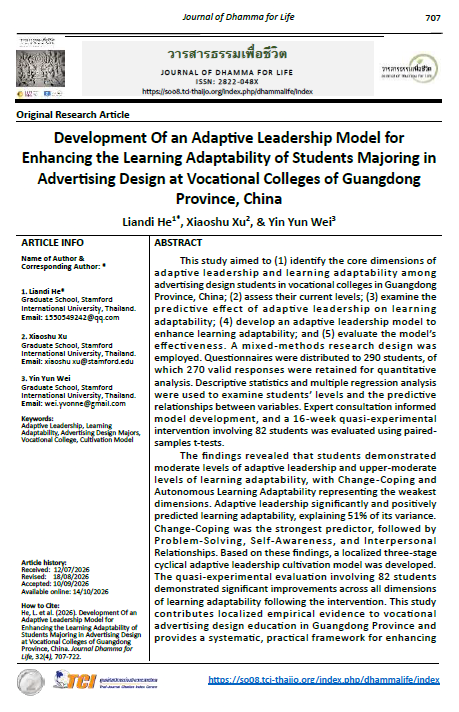
This study aimed to (1) identify the core dimensions of adaptive leadership and learning adaptability among advertising design students in vocational colleges in Guangdong Province, China; (2) assess their current levels; (3) examine the predictive effect of adaptive leadership on learning adaptability; (4) develop an adaptive leadership model to enhance learning adaptability; and (5) evaluate the model’s effectiveness. A mixed-methods research design was employed. Questionnaires were distributed to 290 students, of which 270 valid responses were retained for quantitative analysis. Descriptive statistics and multiple regression analysis were used to examine students’ levels and the predictive relationships between variables. Expert consultation informed model development, and a 16-week quasi-experimental intervention involving 82 students was evaluated using paired-samples t-tests.
The findings revealed that students demonstrated moderate levels of adaptive leadership and upper-moderate levels of learning adaptability, with Change-Coping and Autonomous Learning Adaptability representing the weakest dimensions. Adaptive leadership significantly and positively predicted learning adaptability, explaining 51% of its variance. Change-Coping was the strongest predictor, followed by Problem-Solving, Self-Awareness, and Interpersonal Relationships. Based on these findings, a localized three-stage cyclical adaptive leadership cultivation model was developed. The quasi-experimental evaluation involving 82 students demonstrated significant improvements across all dimensions of learning adaptability following the intervention. This study contributes localized empirical evidence to vocational advertising design education in Guangdong Province and provides a systematic, practical framework for enhancing students’ learning adaptability and employability in the AIGC-driven creative industry.
Article Details
References
Akkermans, J., Brenninkmeijer, V., Schaufeli, W. B., & Blonk, R. W. B. (2013). The role of career competencies in the job search process. Journal of Vocational Behavior, 82(1), 18–26. https://doi.org/10.1016/j.jvb.2012.10.001
Black, I., & Gray, J. (2023). Constructing simulated industry change practice projects to improve students' change-coping ability. Journal of Applied Learning Research, 18(1), 73–82.
Brown, C., & Jones, D. (2024). Carrying out interdisciplinary project-based learning activities to improve learning adaptability. Journal of Interdisciplinary Studies, 18(3), 20–35.
Chen, G. Y. (2021). Localized construction of adaptive leadership cultivation system for vocational students. Vocational Education Development Research, 12(5), 36–43.
Deitmer, H. (2010). Professional development and adaptive learning in vocational education and training. International Journal of Training Research, 8(3), 188–202.
Green, G., & White, H. (2021). Assisting students' self-cognition with the aid of AI-driven vocational assessment tools. Journal of Career Assessment, 29(2), 19–25.
Heifetz, R. A., & Linsky, M. (2002). Leadership on the line: Staying alive through the dangers of leading. Harvard Business School Press.
Heifetz, R. A., Grashow, A., & Linsky, M. (2009). The practice of adaptive leadership: Tools and tactics for changing your organization and the world. Harvard Business Press.
Heifetz, R. A., & Linsky, M. (2017). Leadership on the line: How leaders stay alive (2nd ed.). Harvard Business School Press.
Krejcie, R. V., & Morgan, D. W. (1970). Determining sample size for research activities. Educational and Psychological Measurement, 30(3), 607–610. https://doi.org/10.1177/ 001316447003000308
Li, C. (2018). Learning adaptability and its influencing factors among vocational college students. Journal of Vocational Education Research, 39(4), 45–52.
Liu, Y. (2019). Improving students' change-coping ability through industry lectures and enterprise internships. Chinese Adult Education, 28(4), 15–22.
Liu, Y. (2019). Improving students' change-coping ability through industry lectures and enterprise internships. Chinese Adult Education, 28(4), 15–22.
Moore, Q., & Johnson, R. (2021). Using online learning platforms to improve students' autonomous learning abilities. Online Learning Research Journal, 15(2), 252–269.
Pintrich, P. R. (2003). Motivation and classroom learning. In Handbook of Psychology: Educational Psychology (Vol. 7, pp. 103–122).
Smith, J., & Brown, K. (2020). Digital transformation and talent training reform in advertising industry. Journal of Cultural and Creative Industry Education, 8(2), 45–53.
Sun, Y. (2018). The influence of individual adaptive cognition on students’ learning adaptation. Vocational Education Forum, 9(6), 78–83.
Sunderman, L., Carter, S., & Miles, R. (2020). Distributed adaptive leadership in team-based learning environments. Journal of Educational Leadership, 26(3), 210–225.
Taylor, B., & Anderson, A. (2024). Interpersonal collaboration mechanisms in design project learning. Journal of Creative Education, 20(2), 55–68.
Williams, T., Clark, R., & Scott, M. (2017). Adaptive leadership functions in vocational training teams. International Journal of Vocational Education, 29(4), 301–315.
Wilson, D., & Davis, S. (2024). Creative problem-solving and psychological adaptation in design education. Journal of Design Education Research, 19(1), 89–102.
Wu, L. (2021). Interpersonal interaction and learning adaptability of vocational college students. Educational Psychology Research, 33(5), 90–96.
Zhang, Q., & Wang, L. (2021). Adaptive competency and learning adaptability of vocational students. Vocational Education Management, 14(8), 44–50.
Zhao, X. (2023). Current situation and optimization path of vocational advertising design teaching under digital transformation. Guangdong Vocational Education Research, 10(2), 22–29.
Zhou, N. N. (2020). Carrying out enterprise internships to improve learning adaptability. Vocational and Technical Education, 41(2), 112–118.
