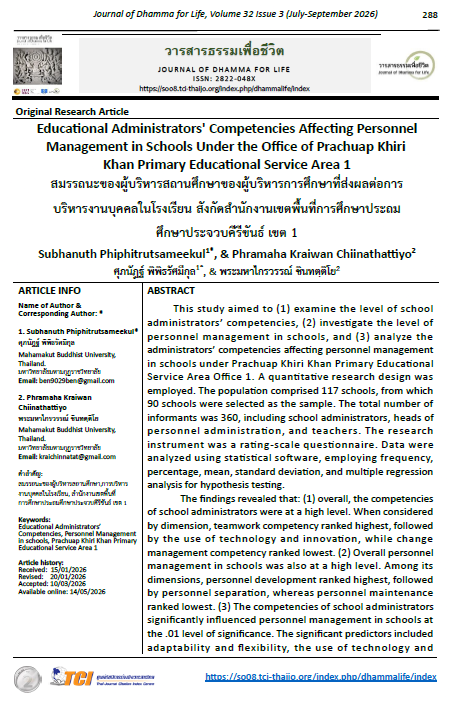
Educational Administrators' Competencies Affecting Personnel Management in Schools Under the Office of Prachuap Khiri Khan Primary Educational Service Area 1
Article Sidebar
Main Article Content
Abstract
This study aimed to (1) examine the level of school administrators’ competencies, (2) investigate the level of personnel management in schools, and (3) analyze the administrators’ competencies affecting personnel management in schools under Prachuap Khiri Khan Primary Educational Service Area Office 1. A quantitative research design was employed. The population comprised 117 schools, from which 90 schools were selected as the sample. The total number of informants was 360, including school administrators, heads of personnel administration, and teachers. The research instrument was a rating-scale questionnaire. Data were analyzed using statistical software, employing frequency, percentage, mean, standard deviation, and multiple regression analysis for hypothesis testing.
The findings revealed that: (1) overall, the competencies of school administrators were at a high level. When considered by dimension, teamwork competency ranked highest, followed by the use of technology and innovation, while change management competency ranked lowest. (2) Overall personnel management in schools was also at a high level. Among its dimensions, personnel development ranked highest, followed by personnel separation, whereas personnel maintenance ranked lowest. (3) The competencies of school administrators significantly influenced personnel management in schools at the .01 level of significance. The significant predictors included adaptability and flexibility, the use of technology and innovation, and change management competency. These variables collectively accounted for 70.7% of the variance (R² = 0.707), with a multiple correlation coefficient of 0.841 and a standard error of estimate of 0.268. The predictive equations were as follows: Raw Score Equation: = 0.710 + 0.164 (X3) + 0.202 (X4) + 0.179 (X5) Standard Score Equation: Ẑ = 0.176 (X3) + 0.225 (X4) + 0.195 (X5)
The results underscore the critical role of adaptive capacity, technological competency, and change management in enhancing effective personnel management in schools. These findings provide empirical evidence to inform policy and practice aimed at strengthening leadership capacity and improving human resource management in educational institutions.
Article Details
References
กัณฑ์พงษ์ นามเสน่ห์. (2559). หลักพรหมวิหารธรรมกับการประยุกต์ใช้ในการบริหารองค์กร. กรุงเทพฯ: สำนักพิมพ์แห่งจุฬาลงกรณ์มหาวิทยาลัย.
กิตติ สมอุ่มจารย์, และคณะ. (2568). การประยุกต์ใช้หลักวุฒิธรรมในการพัฒนาภาวะผู้นำยุคดิจิทัล. วารสารพุทธศาสตร์และการพัฒนา, 12(1), 45–60.
กุลภัสสร ป้องคำ. (2563). สมรรถนะของผู้บริหารสถานศึกษาในศตวรรษที่ 21. วารสารบริหารการศึกษา, 15(2), 1–18.
จารียา ขุนณรงค์, และสุพจน์ แสงเงิน. (2566). การประยุกต์ใช้แนวคิดสมรรถนะในการบริหารทรัพยากรมนุษย์ภาครัฐ. วารสารรัฐประศาสนศาสตร์, 21(3), 650–665.
จีรพรณัฏฐ์ ภุมรินทร์, และสายสุดา เตียเจริญ. (2562). การบริหารการเปลี่ยนแปลงในสถานศึกษา. วารสารศึกษาศาสตร์, 10(3), 33–50.
ชมพูนุช กำบังภัย. (2567). ปัจจัยที่ส่งผลต่อการขาดแคลนครูในสถานศึกษา. วารสารการบริหารการศึกษา, 18(2), 349–351.
ชัยวุฒิ เทโพธิ์, และพงษ์เสฐียร เหลืองอลงกต. (2564). การบริหารทรัพยากรมนุษย์ในสถานศึกษาเพื่อการพัฒนาองค์กร. วารสารการบริหารการศึกษา, 17(1), 55–72.
ชัยวุฒิ เทโพธิ์, และพงษ์เสฐียร เหลืองอลงกต. (2564). สมรรถนะบุคลากรทางการศึกษาและประสิทธิภาพการปฏิบัติงาน. วารสารบริหารการศึกษา, 15(1), 137–150.
ธนิกานต์ ศรีจันทร์, และคณะ. (2564). นโยบายการกระจายอำนาจและการพัฒนาสมรรถนะผู้บริหารสถานศึกษา. วารสารนโยบายการศึกษา, 12(2), 180–195.
ธีรพล ศรีเป๊ะบัว. (2566). อิทธิบาท 4 กับการพัฒนาศักยภาพบุคลากรทางการศึกษา. วารสารพุทธจิตวิทยา, 8(2), 90–104.
พรวิภา สวนมะลิ, และอดุลย์ วังศรีคูณ. (2564). การบริหารงานบุคคลในสถานศึกษา. วารสารวิชาการการศึกษาไทย, 13(2), 25–42.
พระกฤติพงษ์ สุรปญฺโญ. (2567). ไตรลักษณ์กับการบริหารจัดการในโลกยุคใหม่. วารสารพุทธธรรมประยุกต์, 11(1), 12–28.
สำนักงานเขตพื้นที่การศึกษาประถมศึกษาประจวบคีรีขันธ์ เขต 1. (2567). รายงานสภาพปัญหาการบริหารงานบุคคลในสถานศึกษา. ประจวบคีรีขันธ์: ผู้แต่ง.
สำนักงานคณะกรรมการข้าราชการครูและบุคลากรทางการศึกษา. (2565). แนวทางการบริหารงานบุคคลของข้าราชการครูและบุคลากรทางการศึกษา. สำนักปลัดกระทรวงศึกษาธิการ.
อมรรัตน์ เตชะนอก. (2563). บทบาทผู้บริหารสถานศึกษาในการบริหารทรัพยากรมนุษย์. วารสารการบริหารการศึกษาไทย, 14(2), 360–370.
เอกสิทธิ์ สนามทอง. (2562). ช่องว่างระหว่างนโยบายและการปฏิบัติในระบบการศึกษาไทย. วารสารการบริหารและนโยบายการศึกษา, 9(1), 1–15.
คเณศ นามนัย, และคณะ. (2566). ความท้าทายของการจัดการศึกษาภายใต้การเปลี่ยนแปลงของสังคมยุคใหม่. วารสารวิชาการการศึกษา, 20(1), 160–175.
Likert, R. (1932). A technique for the measurement of attitudes. Archives of Psychology.
