
The Role of Apple’s Visual Identity Communication in Shaping Students’ Perception of Symbolic Luxury Image in Bangkok
Article Sidebar
Main Article Content
Abstract
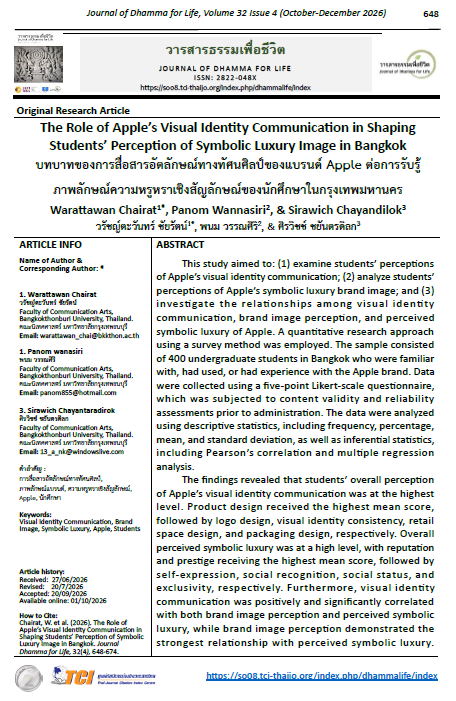
This study aimed to: (1) examine students’ perceptions of Apple’s visual identity communication; (2) analyze students’ perceptions of Apple’s symbolic luxury brand image; and (3) investigate the relationships among visual identity communication, brand image perception, and perceived symbolic luxury of Apple. A quantitative research approach using a survey method was employed. The sample consisted of 400 undergraduate students in Bangkok who were familiar with, had used, or had experience with the Apple brand. Data were collected using a five-point Likert-scale questionnaire, which was subjected to content validity and reliability assessments prior to administration. The data were analyzed using descriptive statistics, including frequency, percentage, mean, and standard deviation, as well as inferential statistics, including Pearson’s correlation and multiple regression analysis.
The findings revealed that students’ overall perception of Apple’s visual identity communication was at the highest level. Product design received the highest mean score, followed by logo design, visual identity consistency, retail space design, and packaging design, respectively. Overall perceived symbolic luxury was at a high level, with reputation and prestige receiving the highest mean score, followed by self-expression, social recognition, social status, and exclusivity, respectively. Furthermore, visual identity communication was positively and significantly correlated with both brand image perception and perceived symbolic luxury, while brand image perception demonstrated the strongest relationship with perceived symbolic luxury. Multiple regression analysis indicated that visual identity communication and brand image perception jointly explained 55.30% of the variance in perceived symbolic luxury. These findings suggest that visual identity serves not merely as a tool for enhancing brand recognition but also as a strategic communication mechanism that connects design with brand image and symbolic value, particularly in terms of modernity, taste, social status, and consumer self-expression.
Article Details
References
การท่องเที่ยวแห่งประเทศไทย. (2563). โครงการสำรวจพฤติกรรมการเดินทางท่องเที่ยวของชาวไทย พ.ศ. 2563. กองวิจัยการตลาดการท่องเที่ยว.
Aaker, D. A. (1996). Building Strong Brands. Free Press.
Aaker, J. L. (1997). Dimensions of brand personality. Journal of Marketing Research, 34(3), 347–356.
Apple Inc. (2013). Apple identity guidelines for channel affiliates and Apple-certified individuals. Apple. Apple Identity Guidelines
Barthes, R. (1977). Image, music, text (S. Heath, Trans. & Ed.). Fontana Press.
Baudrillard, J. (1998). The consumer society: Myths and structures (G. Ritzer, Trans.). SAGE Publications.
Blumer, H. (1969). Symbolic interactionism: Perspective and method. Prentice-Hall.
Bourdieu, P. (1984). Distinction: A social critique of the judgement of taste (R. Nice, Trans.). Harvard University Press.
Cochran, W. G. (1977). Sampling techniques (3rd ed.). John Wiley & Sons.
Eco, U. (1976). A theory of semiotics. Indiana University Press.
Featherstone, M. (1991). Consumer culture and postmodernism. SAGE Publications.
Keller, K. L. (1993). Conceptualizing, measuring, and managing customer-based brand equity. Journal of Marketing, 57(1), 1–22.
Henderson, P. W., & Cote, J. A. (1998). Guidelines for selecting or modifying logos. Journal of Marketing, 62(2), 14–30. https://doi.org/10.1177/002224299806200202
Levy, S. J. (1959). Symbols for sale. Harvard Business Review, 37(4), 117–124.
Melewar, T. C., & Saunders, J. (1998). Global corporate visual identity systems. International Marketing Review, 15(4), 291–308.
Olins, W. (2014). Brand New: The Shape of Brands to Come. Thames & Hudson.
UNESCO. (2021). Media and information literate citizens: Think critically, click wisely. UNESCO. UNESCO – Media and Information Literate Citizens
Van den Bosch, A. L. M., de Jong, M. D. T., & Elving, W. J. L. (2005). How corporate visual identity supports reputation. Corporate Communications: An International Journal, 10(2), 108–116.
Vigneron, F., & Johnson, L. W. (2004). Measuring perceptions of brand luxury. Journal of Brand Management, 11(6), 484–506.
Wheeler, A. (2018). Designing Brand Identity: An Essential Guide for the Whole Branding Team (5th ed.). Wiley.
Wiedmann, K. P., Hennigs, N., & Siebels, A. (2009). Value-based segmentation of luxury consumption behavior. Psychology & Marketing, 26(7), 625–651.
Zou, Y. (2023). Apple’s brand marketing strategy: A case study on brand image and customer engagement. Highlights in Business, Economics and Management, 23, 712–715. https://doi.org/10.54097/sbcggy69
