Redefining Peace at the Crossroads: Multilateralism, Justice, and Sustainability in the United Nations General Assembly (UNGA) 2025
Article Sidebar
Main Article Content
บทคัดย่อ
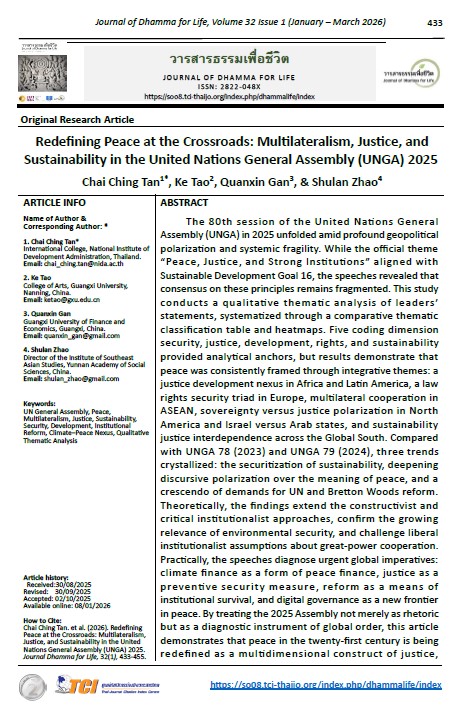
The 80th session of the United Nations General Assembly (UNGA) in 2025 unfolded amid profound geopolitical polarization and systemic fragility. While the official theme “Peace, Justice, and Strong Institutions” aligned with Sustainable Development Goal 16, the speeches revealed that consensus on these principles remains fragmented. This study conducts a qualitative thematic analysis of leaders’ statements, systematized through a comparative thematic classification table and heatmaps. Five coding dimension security, justice, development, rights, and sustainability provided analytical anchors, but results demonstrate that peace was consistently framed through integrative themes: a justice development nexus in Africa and Latin America, a law rights security triad in Europe, multilateral cooperation in ASEAN, sovereignty versus justice polarization in North America and Israel versus Arab states, and sustainability justice interdependence across the Global South. Compared with UNGA 78 (2023) and UNGA 79 (2024), three trends crystallized: the securitization of sustainability, deepening discursive polarization over the meaning of peace, and a crescendo of demands for UN and Bretton Woods reform. Theoretically, the findings extend the constructivist and critical institutionalist approaches, confirm the growing relevance of environmental security, and challenge liberal institutionalist assumptions about great-power cooperation. Practically, the speeches diagnose urgent global imperatives: climate finance as a form of peace finance, justice as a preventive security measure, reform as a means of institutional survival, and digital governance as a new frontier in peace. By treating the 2025 Assembly not merely as rhetoric but as a diagnostic instrument of global order, this article demonstrates that peace in the twenty-first century is being redefined as a multidimensional construct of justice, sustainability, and legitimacy yet fractured by sovereignty-first resistance.
Article Details
เอกสารอ้างอิง
Acharya, A. (2014). Constructing a security community in Southeast Asia: ASEAN and the problem of regional order (3rd ed.). Routledge.
Arce, L. (2025, September 24). Statement by H.E. Luis Alberto Arce Catacora, President of the Plurinational State of Bolivia. General Debate of the 80th Session of the UNGA. United Nations. https://gadebate.un.org/en/80/bolivia.
Balakrishnan, V. (2025, September 27). Statement by H.E. Vivian Balakrishnan, Minister for Foreign Affairs of Singapore. General Debate of the 80th Session of the UNGA. United Nations. https://gadebate.un.org/en/80/singapore.
Bäckstrand, K., & Lövbrand, E. (Eds.). (2015). Research handbook on climate governance. Edward Elgar Publishing. https://doi.org /10.4337/9781783470600.
Barnett, J., Matthew, R., & O’Brien, K. (2010). Global environmental change and human security: An introduction. Environmental Science, Political Science. https://doi.org /10.1007/978-3-540-75977-5_24.
Baturo, A., Dasandi, N., & Mikhaylov, S. J. (2017). Understanding state preferences with text as data: Introducing the UN General Debate corpus. Research & Politics, 4(2), 1–9. https://doi.org/10.1177/2053168017712821.
Binder, M., & Heupel, M. (2015). The legitimacy of the UN Security Council: Evidence from recent General Assembly debates. International Studies Quarterly, 59(2), 238–250. https://doi.org /10.1111/isqu.12145.
Braun, V., & Clarke, V. (2006). Using thematic analysis in psychology. Qualitative Research in Psychology, 3(2), 77–101. https://doi.org/10.1191/1478088706qp063oa.
Cooper, Y. (2025, September 22). Statement by H.E. Yvette Cooper, Prime Minister of the United Kingdom. General Debate of the 80th Session of the UNGA. United Nations. https://gadebate.un.org/en/80/united-kingdom
Escobar, A. (2011). Encountering development: The making and unmaking of the Third World (2nd ed.). Princeton University Press.
Finnemore, M., & Sikkink, K. (1998). International norm dynamics and political change. International Organization, 52(4), 887–917. https://doi.org/10.1162/002081898550789.
Guterres, A. (2025, September). UN Secretary-General’s address at the opening of the 80th sessionof theGeneralAssembly.UniteNations. https://www.un.org/sg/en/ content/sg/statement.
Hale, T.N. (2008). Transparency, Accountability, and Global Governance. Global Governance, 14(1), 73-94. https://www.jstor.org/stable/27800692
Hansen, L. (2006). Security as practice: Discourse analysis and the Bosnian war. Routledge.
Homer-Dixon, T. (1999). Environment, scarcity, and violence. Princeton University Press.
Hurrell, A. (2007). On global order: Power, values, and the constitution of international society. Oxford University Press.
Ishiba, S. (2025, September 24). Statement by H.E. Shigeru Ishiba, Prime Minister of Japan. General Debate of the 80th Session of the UNGA. United Nations. https://gadebate.un.org/en/80/japan
Keohane, R. O., & Nye, J. S. (2012). Power and interdependence: World politics in transition. Longman, Pearson.
Kratochwil, F. V. (1989). Rules, norms, and decisions: On the conditions of practical and legal reasoning in international relations and domestic affairs. Cambridge University Press.
Lake, D. A., Martin, L. L., & Risse, T. (2021). Challenges to the liberal order: Reflections on international organization. International Organization, 75(2), 225–257. https://doi.org/ 10.1017/S0020818320000636.
Li, Q. (2025, September 26). Statement by H.E. Li Qiang, Premier of the State Council of the People’s Republic of China. General Debate of the 80th Session of the UNGA. United Nations. https://gadebate.un.org/en/80/china.
Lula da Silva, L. I. (2025, September 23). Statement by H.E. Luiz Inácio Lula da Silva, President of the Federative Republic of Brazil. General Debate of the 80th Session of the UNGA. United Nations. https://gadebate.un.org/en/80/brazil.
Macron, E. (2025, September 22). Statement by H.E. Emmanuel Macron, President of the French Republic. General Debate of the 80th Session of the UNGA. United Nations. https://gadebate.un.org/en/80/france.
Mahama, J. (2025, September 25). Statement by H.E. John Dramani Mahama, President of the Republic of Ghana. General Debate of the 80th Session of the UNGA. United Nations. https://gadebate.un.org/en/80/ghana.
Mach, K. J., Kraan, C. M., Adger, W. N., Buhaug, H., Burke, M., Fearon, J. D., Field, C.B., Hendrix, C.S., Maystadt, J.F., O’Loughlin, J., Roesler, P., Scheffran, J., Schultz, K.A., & von Uexkull, N. (2019). Climate as a risk factor for armed conflict. Nature, 571(7764), 193–197. https://doi.org /10.1038/s41586-019-1300-6.
Mikhaylov, S. J., Baturo, A., & Dasandi, N. (2020). United Nations General Debate Corpus (UNGDC), 1970–2018. Harvard Dataverse. https://doi.org/10.7910/DVN/0TJX8Y.
Murithi, T. (1008). The African Union’s evolving role in peace operations: the African Union Mission in Burundi, the African Union Mission in Sudan and the African Union Mission in Somalia. African Security Review, 17(1), 69-82. https://doi.org /10.1080/10246029. 2008.9627460.
Netanyahu, B. (2025, September 26). Statement by H.E. Benjamin Netanyahu, Prime Minister of the State of Israel. General Debate of the 80th Session of the UNGA. United Nations. https://gadebate.un.org/en/80/israel
Onuf, N. (1998). Constructivism: A user’s manual. In V. Kubálková, N. Onuf, & P. Kowert (Eds.), International relations in a constructed world (pp. 58–78). M. E. Sharpe.
Peterson, M. J. (2006). The United Nations General Assembly. Routledge.
Petro, G. (2025, September 23). Statement by H.E. Gustavo Petro Urrego, President of the Republic of Colombia. General Debate of the 80th Session of the UNGA. United Nations. https://gadebate.un.org/en/80/colombia.
Ramaphosa, C. (2025, September 25). Statement by H.E. Cyril Ramaphosa, President of the Republic of South Africa. General Debate of the 80th Session of the UNGA. United Nations. https://gadebate.un.org/en/80/south-africa
Ruto, W. (2025, September 24). Statement by H.E. William Samoei Ruto, President of the Republic of Kenya. General Debate of the 80th Session of the UNGA. United Nations. https://gadebate.un.org/en/80/kenya.
Shettima, K. (2025, September 24). Statement by H.E. Kashim Shettima, Vice President of the Federal Republic of Nigeria. General Debate of the 80th Session of the UNGA. United Nations. https://gadebate.un.org/en/80/nigeria.
Trump, D. J. (2025, September 24). Statement by H.E. Donald J. Trump, President of the United States of America. General Debate of the 80th Session of the UNGA. United Nations. https://gadebate.un.org/en/80/united-states.
United Nations. (2023). General Assembly of the United Nations: 78th session general debate statements. https://gadebate.un.org/en/sessions-archive.
United Nations. (2024). General Assembly of the United Nations: 79th session general debate statements. https://gadebate.un.org/en/sessions-archive.
Weiss, T. G., & Daws, S. (Eds.). (2018). The Oxford Handbook on the United Nations (2nd ed.). Oxford University Press.
Wiener, A. (2018). Contestation and constitution of norms in global international relations. Cambridge University Press. https://doi.org /10.1017/9781316718599.
Zarakol, A. (2022). Before the West: The rise and fall of Eastern world orders. Cambridge University Press.
Zelenskyy, V. (2025, September 24). Statement by H.E. Volodymyr Zelenskyy, President of Ukraine. General Debate of the 80th Session of the UNGA. United Nations. https://gadebate.un.org/en/80/ukraine.
Zürn, M. (2018). A Theory of Global Governance: Authority, Legitimacy and Contestation. Oxford University Press.
