Integrating Theravada Buddhist Philosophy in Promoting Peace
Article Sidebar
Main Article Content
Abstract
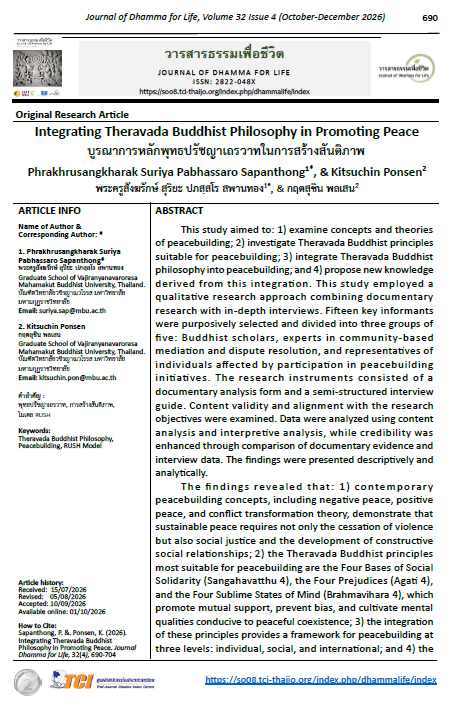
This study aimed to: 1) examine concepts and theories of peacebuilding; 2) investigate Theravada Buddhist principles suitable for peacebuilding; 3) integrate Theravada Buddhist philosophy into peacebuilding; and 4) propose new knowledge derived from this integration. This study employed a qualitative research approach combining documentary research with in-depth interviews. Fifteen key informants were purposively selected and divided into three groups of five: Buddhist scholars, experts in community-based mediation and dispute resolution, and representatives of individuals affected by participation in peacebuilding initiatives. The research instruments consisted of a documentary analysis form and a semi-structured interview guide. Content validity and alignment with the research objectives were examined. Data were analyzed using content analysis and interpretive analysis, while credibility was enhanced through comparison of documentary evidence and interview data. The findings were presented descriptively and analytically.
The findings revealed that: 1) contemporary peacebuilding concepts, including negative peace, positive peace, and conflict transformation theory, demonstrate that sustainable peace requires not only the cessation of violence but also social justice and the development of constructive social relationships; 2) the Theravada Buddhist principles most suitable for peacebuilding are the Four Bases of Social Solidarity (Sangahavatthu 4), the Four Prejudices (Agati 4), and the Four Sublime States of Mind (Brahmavihara 4), which promote mutual support, prevent bias, and cultivate mental qualities conducive to peaceful coexistence; 3) the integration of these principles provides a framework for peacebuilding at three levels: individual, social, and international; and 4) the principal contribution of this study is the RUSH Model (Right Understanding, Universal Loving-kindness, Social Justice, and Harmony), which integrates Theravada Buddhist philosophy with contemporary peacebuilding concepts. The model emphasizes right understanding, universal loving-kindness, social justice, and harmony as interconnected foundations for a systematic approach to promoting stable and sustainable peace.
Article Details
References
กัลยา กุลสุวรรณ. (2550). วรรณกรรมพุทธศาสนา: สันติสุขและสันติภาพของสังคมไทย. มหาวิทยาลัยราชภัฏมหาสารคาม.
ชัยวัฒน์ สถาอานันท์. (2554). อาวุธมีชีวิต? แนวคิดเชิงวิพากษ์ว่าด้วยความรุนแรง. ฟ้าเดียวกัน.
ประเวช วะทาแก้ว, สิริพร ครองชีพ, กฤตพิศิษฏ์ ปูรณภัทร์ธนากุล, นรารัตน์ สงวนทรัพย์, และพระมหาวสันต์ วสนฺโต. (2567). การพัฒนาการเสริมสร้างชุมชนสันติภาพตามแนวพุทธปรัชญาเถรวาท. วารสารบัณฑิตศาส์น มหาวิทยาลัยมหามกุฏราชวิทยาลัย, 22(2).
ปัณณพงศ์ วงศ์ณาศรี. (2558). การจัดการความขัดแย้งและการสร้างความปรองดองในสังคมไทย. วารสารสังคมศาสตร์.
พระธรรมโกศาจารย์ (พุทธทาสภิกขุ). (2541). สันติภาพของโลก. ธรรมสภา.
พระธรรมปิฎก (ป.อ. ปยุตฺโต). (2540). การศึกษาเพื่อสันติภาพ. มูลนิธิพุทธธรรม.
พระพรหมคุณาภรณ์ (ป.อ. ปยุตฺโต). (2556). สลายความขัดแย้ง. ผลิธัมม์.
พระมหานิพนธ์ ลทฺธคุโณ (ปิ่นประดับ), สรวิชญ์ วงษ์สอาด, และวรากรณ์ พูลสวัสดิ์. (2568). อคติ 4 กับความขัดแย้ง. วารสารชัยภูมิปริทรรศน์, 8(1), 17–26.
มหาจุฬาลงกรณราชวิทยาลัย. (2539). พระไตรปิฎกภาษาไทย ฉบับมหาจุฬาลงกรณราชวิทยาลัย. โรงพิมพ์มหาจุฬาลงกรณราชวิทยาลัย.
วรรณา พลรบ. (2567). หลักพุทธธรรมในการสร้างความสงบสุขของโลกยุคใหม่. The Journal of Institute of Trainer Monk Development, 7(4), 645–660.
สมเด็จพระพุทธโฆษาจารย์ (ประยุทธ์ ปยุตฺโต). (2561). การพัฒนาที่ยั่งยืน (พิมพ์ครั้งที่ 21). ผลิธัมม์.
Galtung, J. (1969). Violence, peace, and peace research. Journal of Peace Research, 6(3), 167–191.
Lederach, J. P. (1995). Preparing for peace: Conflict transformation across cultures. Syracuse University Press.
Payutto, P. A. (1994). Buddhist economics: A middle way for the market place (J. B. Dhammavijaya & B. Evans, Trans.; 2nd ed.). Buddhadhamma Foundation.
