Participatory Management Model of Private Schools under the Office of the Private Education Commission
Article Sidebar
Main Article Content
Abstract
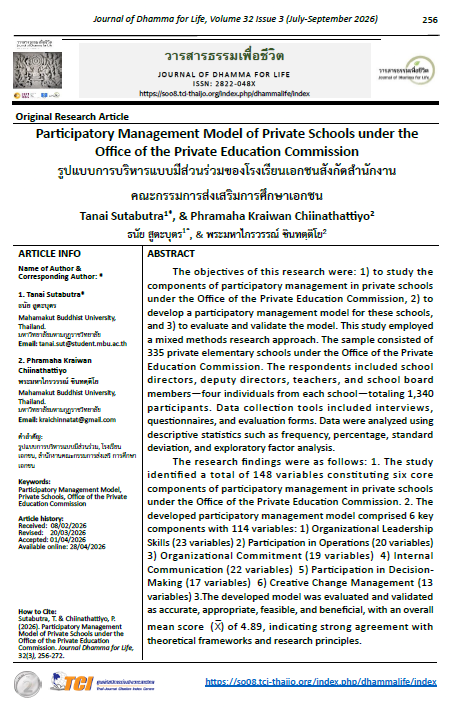
The objectives of this research were: 1) to study the components of participatory management in private schools under the Office of the Private Education Commission, 2) to develop a participatory management model for these schools, and 3) to evaluate and validate the model. This study employed a mixed methods research approach. The sample consisted of 335 private elementary schools under the Office of the Private Education Commission. The respondents included school directors, deputy directors, teachers, and school board members—four individuals from each school—totaling 1,340 participants. Data collection tools included interviews, questionnaires, and evaluation forms. Data were analyzed using descriptive statistics such as frequency, percentage, standard deviation, and exploratory factor analysis.
The research findings were as follows: 1. The study identified a total of 148 variables constituting six core components of participatory management in private schools under the Office of the Private Education Commission. 2. The developed participatory management model comprised 6 key components with 114 variables: 1) Organizational Leadership Skills (23 variables) 2) Participation in Operations (20 variables) 3) Organizational Commitment (19 variables) 4) Internal Communication (22 variables) 5) Participation in Decision-Making (17 variables) 6) Creative Change Management (13 variables) 3.The developed model was evaluated and validated as accurate, appropriate, feasible, and beneficial, with an overall mean score ( ) of 4.89, indicating strong agreement with theoretical frameworks and research principles.
Article Details
References
กัญวัญญ์ ธารีบุญ, & นพดล เจนอักษร. (2563). การมีส่วนร่วมของครูในการบริหารสถานศึกษาเอกชนและผลต่อประสิทธิภาพการจัดการเรียนการสอน. วารสารการบริหารการศึกษา, 14(2), 45–60.
ทิศนา แขมมณี. (2553). ศาสตร์การสอน: องค์ความรู้เพื่อการจัดกระบวนการเรียนรู้ที่มีประสิทธิภาพ. กรุงเทพฯ: สำนักพิมพ์แห่งจุฬาลงกรณ์มหาวิทยาลัย.
บุญทัน ดอกไธสง. (2550). การบริหารการศึกษาและการพัฒนาองค์กรทางการศึกษา. กรุงเทพฯ: สำนักพิมพ์แห่งจุฬาลงกรณ์มหาวิทยาลัย.
พระบาทสมเด็จพระปรมินทรมหาภูมิพลอดุลยเดช. (2505). พระบรมราโชวาทพระราชทานในพิธีพระราชทานปริญญาบัตร วิทยาลัยวิชาการศึกษา วันที่ 13 ธันวาคม พ.ศ. 2505.
พระบาทสมเด็จพระปรมินทรมหาภูมิพลอดุลยเดช. (2524). พระบรมราโชวาทพระราชทานแก่คณะครูและนักเรียนที่ได้รับพระราชทานรางวัล ณ ศาลาดุสิดาลัย วันที่ 27 กรกฎาคม พ.ศ. 2524.
ไกรสิทธิ์ ดิบรุณย์, & ธารินทร์ รสานนท์. (2564). การมีส่วนร่วมของครูในการบริหารงานวิชาการที่ส่งผลต่อประสิทธิผลของโรงเรียน. วารสารวิชาการศึกษาศาสตร์, 22(1), 78–92.
รัตนา มูลป้อม, & พิกุล ภูมิโคกรักษ์. (2565). การบริหารแบบกระจายอำนาจเชิงบูรณาการในสถานศึกษา. วารสารบริหารการศึกษาไทย, 19(3), 33–50.
รัตนา มูลป้อม, และคณะ. (2566). การพัฒนารูปแบบการบริหารแบบมีส่วนร่วมในโรงเรียนเอกชน. วารสารวิจัยและพัฒนาการศึกษา, 28(1), 101–118.
สมคิด พรมแดง. (2552). การบริหารสถานศึกษาเชิงระบบและการมีส่วนร่วม. กรุงเทพฯ: สำนักพิมพ์แห่งจุฬาลงกรณ์มหาวิทยาลัย.
Bardo, J. W., & Hardman, J. J. (1982). Urban society: A systematic introduction. New York: F.E. Peacock Publishers.
Davis, K. (1981). Human behavior at work: Organizational behavior. New York: McGraw-Hill.
Goleman, D. (2005). Emotional intelligence: Why it can matter more than IQ. New York: Bantam Books.
Likert, R. (1967). The human organization: Its management and value. New York: McGraw-Hill.
Yukl, G. (1981). Leadership in organizations. Englewood Cliffs, NJ: Prentice-Hall.
