Developing the New Training Model of Chinese Musical Singing
Article Sidebar
Main Article Content
Abstract
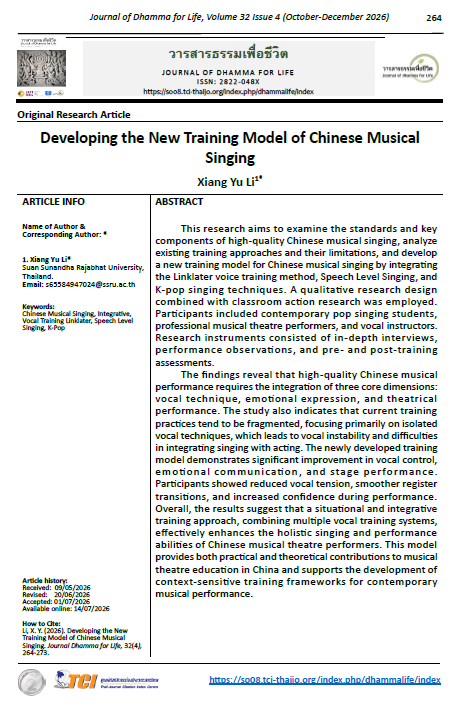
This research aims to examine the standards and key components of high-quality Chinese musical singing, analyze existing training approaches and their limitations, and develop a new training model for Chinese musical singing by integrating the Linklater voice training method, Speech Level Singing, and K-pop singing techniques. A qualitative research design combined with classroom action research was employed. Participants included contemporary pop singing students, professional musical theatre performers, and vocal instructors. Research instruments consisted of in-depth interviews, performance observations, and pre- and post-training assessments.
The findings reveal that high-quality Chinese musical performance requires the integration of three core dimensions: vocal technique, emotional expression, and theatrical performance. The study also indicates that current training practices tend to be fragmented, focusing primarily on isolated vocal techniques, which leads to vocal instability and difficulties in integrating singing with acting. The newly developed training model demonstrates significant improvement in vocal control, emotional communication, and stage performance. Participants showed reduced vocal tension, smoother register transitions, and increased confidence during performance. Overall, the results suggest that a situational and integrative training approach, combining multiple vocal training systems, effectively enhances the holistic singing and performance abilities of Chinese musical theatre performers. This model provides both practical and theoretical contributions to musical theatre education in China and supports the development of context-sensitive training frameworks for contemporary musical performance.
Article Details
References
Bourne, J. (2017). Musical theatre performance: Theory and practice. Routledge.
Chen, G. (2023). Musical theatre education in China: Development, challenges and opportunities. Routledge.
Li, R. (2020). The development of Chinese musical theatre in the twenty-first century. Routledge.
Linklater, K. (2006). Freeing the natural voice: Imagery and art in the practice of voice and language (Revised and expanded ed.). Nick Hern Books.
Liu, H. (2021). Vocal pedagogy and performance integration in Chinese musical theatre education. Chinese Journal of Music Education, 10(3), 67–82.
McCoy, S. J. (2018). Your voice: An inside view (3rd ed.). Inside View Press.
Miller, R. (2019). Securing baritone, bass-baritone, and bass voices. Oxford University Press.
Oh, I., & Park, G. S. (2021). K-pop: The international rise of the Korean music industry. Routledge.
Riggs, S., with Beaty, J. (2018). Singing for the stars: A complete program for training your voice. Alfred Publishing.
Scott, D. (Ed.). (2020). The Ashgate research companion to popular musicology. Routledge.
Sun, L. (2021). Cultural consumption and the rise of musical theatre in urban China. International Journal of Cultural Studies, 24(3), 356–372.
Wang, Q. (2019). Training systems and curriculum gaps in Chinese musical theatre education. Arts Education Research, 8(1), 21–34.
Wang, Y. (2022). Integrating acting and singing in musical theatre pedagogy: A Chinese perspective. Journal of Theatre and Performance Studies, 12(2), 58–74.
Zhang, L. (2022). Reforming vocal training for musical theatre performers in China. Journal of Music and Drama, 18(4), 91–107.
Zhang, L., & Hu, J. (2020). Musical theatre education in China: Problems and prospects. Asian Performing Arts Review, 6(2), 33–48.
