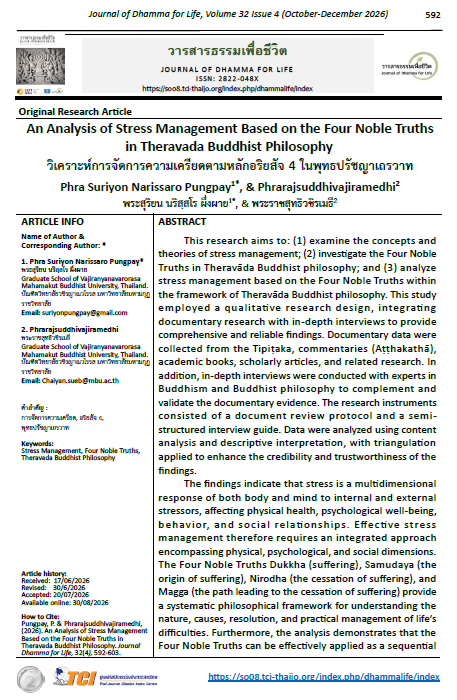
An Analysis of Stress Management Based on the Four Noble Truths in Theravada Buddhist Philosophy
Article Sidebar
Main Article Content
Abstract
This research aims to: (1) examine the concepts and theories of stress management; (2) investigate the Four Noble Truths in Theravāda Buddhist philosophy; and (3) analyze stress management based on the Four Noble Truths within the framework of Theravāda Buddhist philosophy. This study employed a qualitative research design, integrating documentary research with in-depth interviews to provide comprehensive and reliable findings. Documentary data were collected from the Tipiṭaka, commentaries (Aṭṭhakathā), academic books, scholarly articles, and related research. In addition, in-depth interviews were conducted with experts in Buddhism and Buddhist philosophy to complement and validate the documentary evidence. The research instruments consisted of a document review protocol and a semi-structured interview guide. Data were analyzed using content analysis and descriptive interpretation, with triangulation applied to enhance the credibility and trustworthiness of the findings.
The findings indicate that stress is a multidimensional response of both body and mind to internal and external stressors, affecting physical health, psychological well-being, behavior, and social relationships. Effective stress management therefore requires an integrated approach encompassing physical, psychological, and social dimensions. The Four Noble Truths Dukkha (suffering), Samudaya (the origin of suffering), Nirodha (the cessation of suffering), and Magga (the path leading to the cessation of suffering) provide a systematic philosophical framework for understanding the nature, causes, resolution, and practical management of life’s difficulties. Furthermore, the analysis demonstrates that the Four Noble Truths can be effectively applied as a sequential stress management model by promoting awareness and acceptance of stress, identifying its underlying causes, pursuing the cessation of stress, and practicing the Noble Eightfold Path to cultivate balanced physical, mental, and behavioral development. This integrative approach contributes to effective stress management, enhances quality of life, and promotes sustainable well-being.
Article Details
References
เจนจิรา เกียรติสินทรัพย์. (2562). ผลของการใช้โปรแกรมจัดการความเครียดต่อความสามารถจัดการความเครียดและระดับความเครียดของผู้สูงอายุในเขตอำเภอเมืองนนทบุรี. วารสารเกื้อการุณย์, 26(2), 62-70.
ชนาธิป ศรีโท. (2563). ความเข้าใจเรื่องอริสัจ 4 ในพระพุทธศาสนา. วารสารวิชาการพระพุทธศาสนาเขตลุ่มแม่น้ำโขง. มหาวิทยาลัยมหามกุฏราชวิทยาลัย วิทยาเขตอีสาน.
ณัฏฐา ม้วนสุธา. (2565). การจัดการความเครียดของผู้สูงอายุในจังหวัดสุราษฎร์ธานี ตามแนวพุทธศาสนา. ดุษฎีนิพนธ์, ปรัชญาดุษฎีบัณฑิต, สาขาวิชาสังคมวิทยาตามแนวพุทธ, คณะสังคมศาสตร์, มหาวิทยาลัยมหามกุฏราชวิทยาลัย.
ดิลก บุญอิ่ม. (2561). การใช้โยนิโสมนสิการแนวอริยสัจเป็นฐานการเรียนรู้ด้วยตนเองในการดำรงชีวิต. วารสาร มมร.วิชาการล้านนา, 7(1), 51-62.
นฤพันธ์ สมเจริญ. (2568). การประยุกต์หลักอริยสัจ 4 เพื่อการแก้ปัญหาความเครียดในชีวิตประจำวารสารธรรมสาส์น. มหาวิทยาลัยจุฬาลงกรณราชวิทยาลัย.
พระครูสารกิจประยุต (กาบ ฐานตฺโต). (2560). การประยุกต์ใช้หลักอริยสัจ 4 ในการแก้ไขปัญหาชีวิต, วิทยานิพนธ์, บัณฑิตวิทยาลัย: มหาวิทยาลัยมหาจุฬาลงกรณราชวิทยาลัย วิทยาเขตขอนแก่น.
พระทศัพงษ์ ฐานวุโธ. (2566). ความสุขในการเจริญวิปัสสนาตามหลักอริยสัจ 4. วารสาร ปัญญาลิขิต ปีที่2 ฉบับที่ 3.
พระมหาอนันต์ อนุตฺตโร. (2564). การปฏิบัติกรรมฐานเพื่อบำบัดความเครียด วารสารมนุษย์ศาสตร์และสังคมศาสตร์. มหาวิทยาลัยเอเชียอาคเนย์.
อรธีรา มนูจันทรัถ. (2566). ปัจจัยเชิงสาเหตุของความสมดุลในงานและชีวิตส่วนตัวที่ส่งผลต่อภาวะหมดไฟในการทำงานของอาจารย์มหาวิทยาลัยแห่งหนึ่งในจังหวัดนครปฐม, หลักสูตรบริหารธุรกิจมหาบัณฑิต, มหาวิทยาลัยศิลปากร.
Bannaruji, B., Indanyani, & Mahatthanadull, S. (2018). An analytical study of the Four Noble Truths in Theravāda Buddhism. The Journal of the International Association of Buddhist Universities, 11(1), 147–160.
Hanwongburana, P. (2020). Stress management for systemic lupus erythematosus (SLE) patients based on the Buddha’s teaching of mindfulness. The Journal of International Buddhist Studies College, 6(1), 12–25.
Kahn, A. (2021). A Buddhist approach to stress management from the perspective of dependent origination (DOSM). The Journal of International Buddhist Studies College.
Uthayaratana, T., Taephant, N., & Pisitsungkagarn, K. (2019). Four Noble Truths based problem solving: A therapeutic view. Mental Health, Religion & Culture, 22(2), 119–129.
