Dharma and Stress: Applied Buddhism for Thai Society in Transition
Article Sidebar
Main Article Content
Abstract
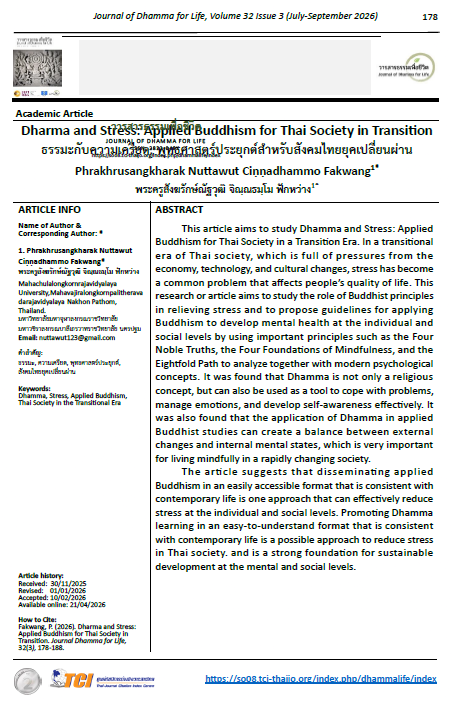
This article aims to study Dhamma and Stress: Applied Buddhism for Thai Society in a Transition Era. In a transitional era of Thai society, which is full of pressures from the economy, technology, and cultural changes, stress has become a common problem that affects people’s quality of life. This research or article aims to study the role of Buddhist principles in relieving stress and to propose guidelines for applying Buddhism to develop mental health at the individual and social levels by using important principles such as the Four Noble Truths, the Four Foundations of Mindfulness, and the Eightfold Path to analyze together with modern psychological concepts. It was found that Dhamma is not only a religious concept, but can also be used as a tool to cope with problems, manage emotions, and develop self-awareness effectively. It was also found that the application of Dhamma in applied Buddhist studies can create a balance between external changes and internal mental states, which is very important for living mindfully in a rapidly changing society.
The article suggests that disseminating applied Buddhism in an easily accessible format that is consistent with contemporary life is one approach that can effectively reduce stress at the individual and social levels. Promoting Dhamma learning in an easy-to-understand format that is consistent with contemporary life is a possible approach to reduce stress in Thai society. and is a strong foundation for sustainable development at the mental and social levels.
Article Details
References
กรมสุขภาพจิต. (2565). รายงานสถานการณ์สุขภาพจิตของประชาชนไทยหลังโควิด-19. กรุงเทพฯ: กรมสุขภาพจิต กระทรวงสาธารณสุข.
ชาญวิทย์. (2563). จิตวิทยาและความทุกข์: แนวทางเยียวยาใจ. เชียงใหม่: สำนักพิมพ์เชียงใหม่.
จำนงค์ อดิวัฒนสิทธิ์. (2548). พุทธศาสตร์กับการพัฒนาคุณธรรมในยุคสังคมเปลี่ยนผ่าน. กรุงเทพฯ: โรงพิมพ์มหาวิทยาลัย.
จิรพัฒน์. (2564). ความเครียดและวัยทำงานไทย. กรุงเทพฯ: สำนักพิมพ์สุขภาพจิต.
จำนงค์ อดิวัฒนสิทธิ์. (2548). พุทธศาสตร์ประยุกต์: แนวทางการนำหลักธรรมมาใช้ในชีวิตประจำวัน. กรุงเทพฯ: สำนักพิมพ์มหาจุฬาลงกรณราชวิทยาลัย.
บุญเลิศ. (2562). ธรรมะกับการพัฒนาจิตใจคนเมือง. กรุงเทพฯ: สำนักพิมพ์ธรรมสาร.
มรรยาท รุจิวิชชญ์. (2013). การจัดการความเครียดด้วยหลักธรรมทางพระพุทธศาสนา. วารสารพุทธศาสน์ศึกษา, 12(2), 45–60.
ระเดชขจร. (2018). ความเครียดและการปรับตัวในสังคมสมัยใหม่. กรุงเทพฯ: สำนักพิมพ์มหาวิทยาลัย ธรรมศาสตร์.
วันพรรษา, ช., & กมลาศ, ส. (2561). ความเครียดและการปรับตัวของคนไทยในยุคสังคมเปลี่ยนผ่าน. กรุงเทพฯ: สำนักพิมพ์มหาวิทยาลัย.
สิริคุโณ. (2022). ธรรมะบำบัดความเครียด: แนวทางปฏิบัติสำหรับผู้สนใจพุทธศาสนา. กรุงเทพฯ: สำนักพิมพ์อมรินทร์.
สมชาย, & อมรเทพ. (2565). ความเครียดในวัยรุ่นและวัยทำงาน: การศึกษาเชิงสังคม. กรุงเทพฯ: สำนักพิมพ์สุขภาพจิต.
สมเด็จพระพุทธโฆษาจารย์. (2533). พุทธศาสตร์ประยุกต์: หลักธรรมเพื่อชีวิตและสังคม. กรุงเทพฯ: มูลนิธิพุทธศาสน์.
สืบนิสัย, อังสุมาลี, โยธิโก, & จันทาพูน. (2568). พุทธศาสตร์ประยุกต์เพื่อการพัฒนาสังคมไทยในยุคเปลี่ยนผ่าน. วารสารพุทธศาสตร์ประยุกต์, 5(1), 1–25.
ธรรมสภาเรียบเรียง. (2020). หลักธรรมและจิตวิทยาแห่งความสุข. กรุงเทพฯ: สำนักพิมพ์ธรรมสภา.
ไรพงษ์ ณ อยุธยา ช., อุดมธรรมานุภาพ เ., & รักขันโท ส. (2568). การประยุกต์สติและสมาธิเพื่อสุขภาพจิตในยุคเทคโนโลยีและความเปลี่ยนแปลง. วารสารจิตวิทยาประยุกต์, 12(2), 45–63.
ศิริพร. (2563). การประยุกต์ใช้ธรรมะในบริบทสมัยใหม่. กรุงเทพฯ: สำนักพิมพ์มหาวิทยาลัย.
ศรีวิไล, & ปิติ. (2564). ผลกระทบของเทคโนโลยีและโลกาภิวัตน์ต่อสุขภาพจิต. นครราชสีมา: สำนักพิมพ์วิชาการ.
อาจารย์ ดร. ไพเราะ. (2565). การจัดการความเครียดเชิงจิตวิญญาณในสังคมไทยยุคดิจิทัล. วารสารการพัฒนาสังคม, 7(1), 101–118.
อรวรรณ. (2564). การจัดการความเครียดเชิงจิตวิทยาในสังคมไทย. กรุงเทพฯ: สำนักพิมพ์มหาวิทยาลัย.
Hanson, R. (2020). Resilient: How to thrive in an uncertain world. New York, NY: Harmony Books.
