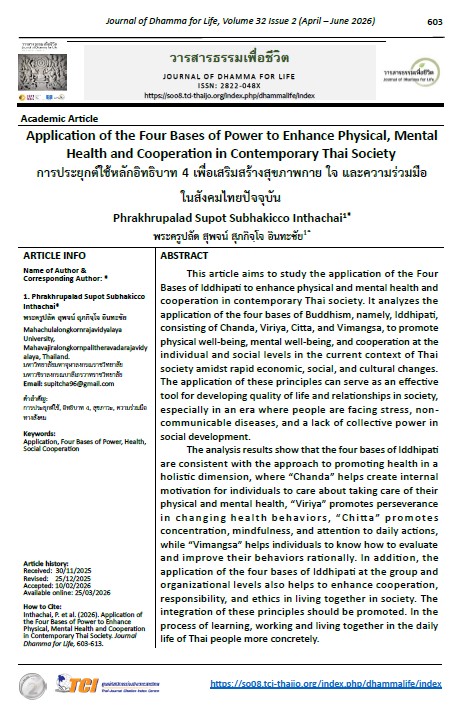
Application of the Four Bases of Power to Enhance Physical, Mental Health and Cooperation in Contemporary Thai Society
Article Sidebar
Main Article Content
Abstract
This article aims to study the application of the Four Bases of Iddhipati to enhance physical and mental health and cooperation in contemporary Thai society. It analyzes the application of the four bases of Buddhism, namely, Iddhipati, consisting of Chanda, Viriya, Citta, and Vimangsa, to promote physical well-being, mental well-being, and cooperation at the individual and social levels in the current context of Thai society amidst rapid economic, social, and cultural changes. The application of these principles can serve as an effective tool for developing quality of life and relationships in society, especially in an era where people are facing stress, non-communicable diseases, and a lack of collective power in social development.
The analysis results show that the four bases of Iddhipati are consistent with the approach to promoting health in a holistic dimension, where “Chanda” helps create internal motivation for individuals to care about taking care of their physical and mental health, “Viriya” promotes perseverance in changing health behaviors, “Chitta” promotes concentration, mindfulness, and attention to daily actions, while “Vimangsa” helps individuals to know how to evaluate and improve their behaviors rationally. In addition, the application of the four bases of Iddhipati at the group and organizational levels also helps to enhance cooperation, responsibility, and ethics in living together in society. The integration of these principles should be promoted. In the process of learning, working and living together in the daily life of Thai people more concretely.
Article Details
References
พระอธิการอำพรรณ โรจนธมฺโม. (2562). อิทธิบาท 4 กับการพัฒนาจิตใจและสุขภาพจิต. กรุงเทพฯ: สำนักพิมพ์ธรรมสถิต.
พระมหาฉัตรชัย ธมฺมวรเมธี, อัญชลี, ก., & สมชาย, ช. (2565). หลักอิทธิบาท 4 และการเสริมสร้างภูมิคุ้มกันทางจิตใจ. กรุงเทพฯ: สำนักพิมพ์ธรรมสภา.
พระพรหมคุณาภรณ์. (2545). อิทธิบาท 4 กับการพัฒนาจิตใจ. กรุงเทพฯ: สำนักพิมพ์ธรรมสภา.
พระพรหมคุณาภรณ์. (2551). หลักอิทธิบาท 4 เพื่อชีวิตที่สมดุล. กรุงเทพฯ: สำนักพิมพ์ธรรมสภา.
พระธีรดา & พระมหาดาวสยาม. (2563). หลักอิทธิบาท 4 กับพฤติกรรมสุขภาพ. กรุงเทพฯ: สำนักพิมพ์พุทธธรรมศึกษา.
พระบุญเสริม & จักรี. (2565). แรงจูงใจภายในและความเพียรพยายามในการสร้างพฤติกรรมสุขภาพระยะยาว. วารสารพฤติกรรมศาสตร์เพื่อสุขภาพ, 7(1), 23–38.
นภาพร เจริญสุข. (2562). การสร้างความร่วมมือในชุมชนผ่านการใช้หลักอิทธิบาท 4 เพื่อการพัฒนาอย่างยั่งยืน. วารสารพัฒนาสังคม, 15(1), 89–101.
มลธิดา. (2564). การประยุกต์หลักอิทธิบาท 4 ต่อสุขภาพจิตของวัยทำงาน. วารสารวิชาการจิตวิทยา, 12(3), 45–59.
ทวีศักดิ์ ประดิษฐ์สุข. (2563). การพัฒนาจิตตะและวิริยะเพื่อความมั่นคงทางอารมณ์. เชียงใหม่: สำนักพิมพ์จิตวิทยาไทย.
Charoenwong, P., Srisuwan, T., & Meesuk, P. (2021). Mental health and social cohesion in Thai communities. Thai Journal of Psychology, 36(2), 45–60.
Lertworasirikul, S., & Wongboonsin, P. (2021). Application of Itthibhat 4 in daily life: Enhancing well-being and social relationships. Journal of Thai Buddhist Studies, 14(1), 101–118.
Phongpaichit, P. (2020). Buddhist ethics in modern Thai society. Bangkok: Chulalongkorn University Press.
Piyawat, K. (2019). Moral foundations and psychological resilience: An empirical study of Itthibhat 4 practice. Asian Journal of Behavioral Science, 7(1), 77–92.
Sukwises, N., & Pongpairoj, T. (2022). Work stress and life balance among Thai employees. Journal of Occupational Health, 64(3), 210–222.
Thanakit, J., & Boonchutima, S. (2023). Community engagement and conflict resolution through Buddhist practices. Thai Journal of Social Work, 9(1), 33–51.
