Anxiety, Stress, Depression and Associated Factors of Caregivers Who Taking Care of Children and Adolescents with Autism Spectrum Disorder Receiving Outpatient Treatment Services at the Child and Adolescent Psychiatry Unit, King Chulalongkorn Memorial Hospital
Article Sidebar
Main Article Content
Abstract
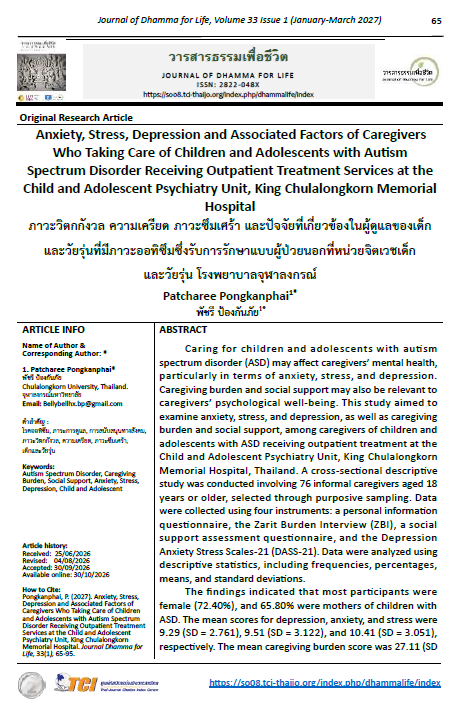
Caring for children and adolescents with autism spectrum disorder (ASD) may affect caregivers’ mental health, particularly in terms of anxiety, stress, and depression. Caregiving burden and social support may also be relevant to caregivers’ psychological well-being. This study aimed to examine anxiety, stress, and depression, as well as caregiving burden and social support, among caregivers of children and adolescents with ASD receiving outpatient treatment at the Child and Adolescent Psychiatry Unit, King Chulalongkorn Memorial Hospital, Thailand. A cross-sectional descriptive study was conducted involving 76 informal caregivers aged 18 years or older, selected through purposive sampling. Data were collected using four instruments: a personal information questionnaire, the Zarit Burden Interview (ZBI), a social support assessment questionnaire, and the Depression Anxiety Stress Scales-21 (DASS-21). Data were analyzed using descriptive statistics, including frequencies, percentages, means, and standard deviations.
The findings indicated that most participants were female (72.40%), and 65.80% were mothers of children with ASD. The mean scores for depression, anxiety, and stress were 9.29 (SD = 2.761), 9.51 (SD = 3.122), and 10.41 (SD = 3.051), respectively. The mean caregiving burden score was 27.11 (SD = 11.882), indicating a mild-to-moderate level of burden. Social support was moderate across all four dimensions: emotional support (M = 3.63), informational support (M = 3.52), appraisal support (M = 3.48), and tangible support and services (M = 3.49). These findings highlight the importance of assessing caregivers’ mental health and caregiving burden while strengthening social support systems to ensure that assistance is appropriate to caregivers’ needs. However, further analysis of associations among the study variables is necessary to establish which factors are related to caregivers’ mental health.
Article Details
References
กรมสุขภาพจิต, สถาบันราชานุกูล. (2548). แนวทางการดูแลออทิสติก. โรงพิมพ์คุรุสภาลาดพร้าว.
แก้วตา นพมณีจำรัสเลิศ, และอินทร์สุดา แก้วกาญจน์. (2560). กระบวนทัศน์ใหม่การดูแลรักษาเด็กออทิสติกสำหรับกุมารแพทย์. วารสารกุมารเวชศาสตร์, 56(1), 6–15.
จิณัฐตา ศุภศรี, อรวรรณ หนูแก้ว, และวันดี สุทธรังษี. (2560). ผลของโปรแกรมการให้สุขภาพจิตศึกษาครอบครัวต่อภาระของผู้ดูแลเด็กออทิสติก: การศึกษาเบื้องต้น. วารสารเครือข่ายวิทยาลัยพยาบาลและการสาธารณสุขภาคใต้, 4(ฉบับพิเศษ). https://he01.tci-thaijo.org/index.php/ scnet/article/view/84871
จีระพรรณ สุริยงค์. (2550). ผลของโปรแกรมการดูแลผู้ป่วยจิตเภทโดยครอบครัวต่อทักษะการดูแลของผู้ดูแลผู้ป่วยโรคจิตเภท โรงพยาบาลสวนปรุง จังหวัดเชียงใหม่. วิทยานิพนธ์พยาบาลศาสตรมหาบัณฑิต, สาขาวิชาการพยาบาลสุขภาพจิตและจิตเวช, คณะพยาบาลศาสตร์, มหาวิทยาลัยเชียงใหม่.
ทวีศักดิ์ สิริรัตนข์เรขา. (2561). คู่มือการดูแลสุขภาพจิตเด็ก กลุ่มปัญหาการเรียน. (พิมพ์ครั้งที่ 2). กรุงเทพมหานคร : สำนักพิมพ์พรอสเพอรัสพลัส
ธารทิพย์ อิ่มทรัพย์. (2548) การสนับสนุนทางสังคม และสัมพันธภาพในครอบครัวของเด็กวัยรุ่นที่พยายามฆ่าตัวตาย จังหวัดนครสวรรค์. วิทยานิพนธ์ปริญญาพยาบาลศาสตรมหาบัณฑิต สาขาวิชาสุขภาพจอตและการพยาบาลจิตเวช บัณฑิตวิทยาลัย มหาวิทยาลัยเชียงใหม่.
นันทินี ศุภมงคล. (2557). ความวิตกกังวล การสนับสนุนทางสังคม และกลวิธีการเผชิญปัญหาของนิสิตนักศึกษา. วิทยานิพนธ์ปริญญาศิลปศาสตรมหาบัณฑิต สาขาจิตวิทยาการปรึกษา คณะจิตวิทยา จุฬาลงกรณ์มหาวิทยาลัย.
นัทธ์ชนัน จรัสจรุงเกียรติ และอลิสา วัชรสินธุ. (2556). คุณภาพชีวิตของผู้ดูแลเด็กที่เป็นโรคในกลุ่มออทิสติกสเปกตรัมและปัจจัยที่เกี่ยวข้อง. วารสารสมาคมจิตแพทย์แห่งประเทศไทย, 58(3), 233–244.
ปาณิสรา เกษมสุข. (2551). ผลของโปรแกรมกลุ่มบำบัดประคับประคองต่อภาระการดูแลและภาวะซึมเศร้าในผู้ดูแลผู้ป่วยจิตเภท [วิทยานิพนธ์, จุฬาลงกรณ์มหาวิทยาลัย]. https://doi.org/10. 14457/CU.the.2008.1016
พจนานุกรม ฉบับราชบัณฑิตยสถาน. (2567). ระบบค้นหาคำศัพท์, สืบค้นเมื่อ 24 กุมภาพันธ์ 2567. จาก https://dictionary.orst.go.th
รุ่งรัตน์ ศรีอำนวย. (2561). ประสบการณ์ชีวิตของพ่อแม่ที่เลี้ยงดูเด็กที่มีภาวะออทิสซึ่ม: เพื่อการใช้ประโยชน์ในการจัดบริการช่วยเหลือระยะแรกเริ่มที่เน้นครอบครัวเป็นศูนย์กลาง. วารสารวิจัยและพัฒนาการศึกษาพิเศษ, 7(1). https://ejournals.swu.ac.th/index.php/rise/article/view/10235
รัชนีกร อุปเสน. (2541). การศึกษาบทบาทและภาระของญาติผู้ดูแลผู้ป่วยจิตเภทที่บ้าน. วิทยานิพนธ์พยาบาลศาสตร์มหาบัณฑิต, สาขาวิชาการพยาบาลสุขภาพจิตและจิตเวช, คณะพยาบาลศาสตร์, มหาวิทยาลัยขอนแก่น.
อรพรรณ ลือบุญธวัชชัย. (2545). การพยาบาลสุขภาพจิตและจิตเวช.กรุงเทพมหานคร: ดานสุธาการพิมพ์
American Psychiatric Association. (2022). Diagnostic and statistical manual of mental disorders (5th ed., text rev.; DSM-5-TR). American Psychiatric Association Publishing. https://doi.org/10.1176/appi.books.9780890425787
Chunvirut, S. (2010). Prevalence of depression and social support in mothers of children with autism aged 3–10 years at outpatient department, Rajanukul Institute. Rajanukul Journal, 25(1).
Ganz, M. L. (2007). The lifetime distribution of the incremental societal costs of autism. Archives of Pediatrics & Adolescent Medicine, 161(4), 343–349. https://doi.org/10.1001/archpedi.161.4.343
Karen Eisen Memger. (2012). Grief and lost potential in the parents of adult children with severe mental illness. Kentucky: University of Louisville.
Lopez AD, Murray CC (1998). The global burden of disease 1990-2020. Nat Med.4:1241-3.
Montgomery, R. J. V., Gonyea, J. G., & Hooyman, N. R. (1985). Caregiving and the experience of subjective and objective burden. Family Relations, 34(1), 19–26. https://doi.org/10.2307/583753
Poolsuppasit, S., Panyayong, B., Liknapichitkul, D., Serisathien, P., & Chutha, W. (2005). Holistic care for Thai autism. Journal of Mental Health of Thailand, 13(1), 10–16. https://he01.tci-thaijo.org/index.php/jmht/article/view/51463
Rogge, N., & Janssen, J. (2019). The economic costs of autism spectrum disorder: A literature review. Journal of Autism and Developmental Disorders, 49(7), 2873–2900. https://doi.org/10.1007/s10803-019-04014-z
Schopler, E., & Mesibov, G. B. (Eds.). (1984). The effects of autism on the family. Plenum Press. https://doi.org/10.1007/978-1-4899-2293-9
Srisinghasongkram, P., Pruksananonda, C., & Chonchaiya, W. (2016). Two-step screening of the Modified Checklist for Autism in Toddlers in Thai children with language delay and typically developing children. Journal of Autism and Developmental Disorders, 46(10), 3317–3329. https://doi.org/10.1007/s10803-016-2876-4
Suwanno, P. (2020). Depression among parents of children and adolescents’ psychiatric patients at Songkhla Hospital. Journal of the Psychiatric Association of Thailand, 65(3), 289–300.
Thoits, P. A. (1982). Conceptual, methodological, and theoretical problems in studying social support as a buffer against life stress. Journal of Health and Social Behavior, 23(2), 145–159.
Wesseldijk, L. W., Dieleman, G. C., van Steensel, F. J. A., Bartels, M., Hudziak, J. J., Lindauer, R. J. L., Bögels, S. M., & Middeldorp, C. M. (2018). Risk factors for parental psychopathology: A study in families with children or adolescents with psychopathology. European Child & Adolescent Psychiatry, 27(12), 1575–1584. https://doi.org/10.1007/s00787-018-1156-6