The Application of Buddhist Philosophy in The Work Performance of Officials at The Songkhla Provincial Office of Buddhism
Article Sidebar
Main Article Content
Abstract
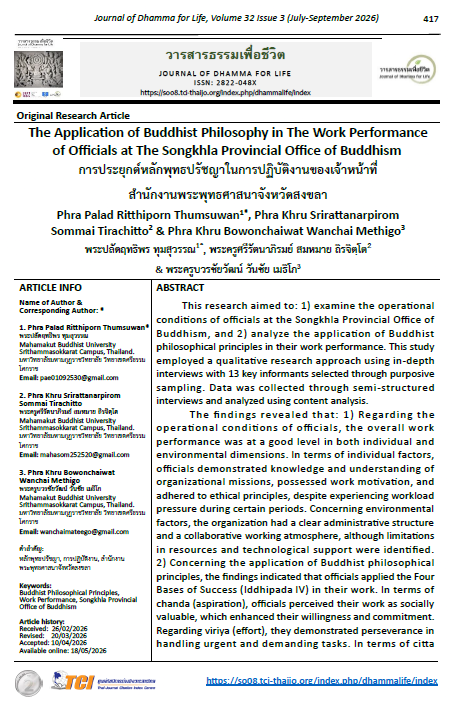
This research aimed to: 1) examine the operational conditions of officials at the Songkhla Provincial Office of Buddhism, and 2) analyze the application of Buddhist philosophical principles in their work performance. This study employed a qualitative research approach using in-depth interviews with 13 key informants selected through purposive sampling. Data was collected through semi-structured interviews and analyzed using content analysis.
The findings revealed that: 1) Regarding the operational conditions of officials, the overall work performance was at a good level in both individual and environmental dimensions. In terms of individual factors, officials demonstrated knowledge and understanding of organizational missions, possessed work motivation, and adhered to ethical principles, despite experiencing workload pressure during certain periods. Concerning environmental factors, the organization had a clear administrative structure and a collaborative working atmosphere, although limitations in resources and technological support were identified. 2) Concerning the application of Buddhist philosophical principles, the findings indicated that officials applied the Four Bases of Success (Iddhipada IV) in their work. In terms of chanda (aspiration), officials perceived their work as socially valuable, which enhanced their willingness and commitment. Regarding viriya (effort), they demonstrated perseverance in handling urgent and demanding tasks. In terms of citta (attentiveness), they performed duties carefully and paid close attention to details to minimize errors. Regarding vimamsa (investigation), they regularly reflected upon problems and sought appropriate improvements in their work processes.
Article Details
References
กันต์พงษ์ เดชอภิรักษ์ชน, & นิรนาท แสงสา. (2563). ความสุขในการทำงานตามหลักพุทธจิตวิทยาของข้าราชการ สังกัดสำนักนโยบายและแผนกลาโหม. วารสารพุทธจิตวิทยา, 5(2), 33–47.
ธเนศ เกษศิลป์, & พระมหาบุญศรี ญาณวุฑฺโฒ (วงค์แก้ว). (2561). การบริหารจัดการภาครัฐแนวใหม่โดยหลักบริหารเชิงพุทธศาสตร์. วารสารบัณฑิตศาส์น มหาวิทยาลัยมหามกุฏราชวิทยาลัย, 16(2), 45–58.
ปกรณ์ มหากันธา. (2557). รูปแบบและกระบวนการบริหารองค์กรปกครองส่วนท้องถิ่นเชิงพุทธบูรณาการ. Community and Social Development Journal, 15(2), 85–97.
พระครูวิจิตรสาธุรส. (2560). การใช้หลักพรหมวิหารธรรมในการบริหารงานของผู้บริหารสถานศึกษาตาม ทัศนะของครูกลุ่มโรงเรียนการกุศล จังหวัดสงขลา. วารสารมหาจุฬานาครทรรศน์. 4 (1), 1-15.
พระครูวินัยธรวันชัย เมธิโก. (2558). การประยุกตใช้พุทธปรัชญาและปรัชญาหลังนวยุค เพื่อเสริมสร้างจิตสำนึกของการมีส่วนร่วมในการแก้ปัญหาน้ำท่วมในอำเภอหาดใหญ่ จังหวัดสงขลา. วารสารสถาบันวิจัยญาณสังวร, 7(2), 189-196.
พระธรรมโกศาจารย์ (พุทธทาสภิกขุ). (2549). อิทธิบาท 4 ธรรมแห่งความสำเร็จ. ธรรมสภา.
พระธรรมปิฎก (ป.อ. ปยุตฺโต). (2546). พจนานุกรมพุทธศาสตร์ ฉบับประมวลธรรม. กรุงเทพฯ: มหาจุฬาลงกรณราชวิทยาลัย.
พระพรหมคุณาภรณ์ (ป.อ. ปยุตฺโต). (2559). พุทธธรรม ฉบับปรับขยาย. กรุงเทพฯ: ผลิธัมม์.
พระมหาสันติ ธีรภทฺโท, & นาถาบำรุง. (2562). การประยุกต์ใช้หลักพุทธธรรมในการบริหารงานภาครัฐเพื่อความปรองดองในสังคมไทย. วารสารบัณฑิตศึกษาปริทรรศน์, 15(1), 112–126.
ศุภิสรา บัวงาม. (2564). การบริหารผลการปฏิบัติงานสู่ผลสัมฤทธิ์การปฏิบัติราชการของสำนักงานพระพุทธศาสนาแห่งชาติ. วารสารวิทยาลัยสงฆ์นครลำปาง, 10(3), 55–70.
สมพร เทพสิทธา. (2550). คุณธรรมและจริยธรรมของข้าราชการ บทบาทของข้าราชการ. กรุงเทพมหานคร : สภาสังคมสงเคราะห์แห่งประเทศไทย.
สำนักงานเลขาธิการสภาผู้แทนราษฎร. (2564). ความไว้วางใจสาธารณะกับธรรมาภิบาลของรัฐไทย. สืบค้นจาก National Assembly Library of Thailand
สุภางค์ จันทวานิช. (2557). วิธีการวิจัยเชิงคุณภาพ. กรุงเทพมหานคร: สำนักพิมพ์แห่งจุฬาลงกรณ์มหาวิทยาลัย.
Allen, N. J., & Meyer, J. P. (1991). A three-component conceptualization of organizational commitment. Human Resource Management Review, 1(1), 61–89.
Herzberg, F. (1959). The motivation to work (2nd ed.). New York, NY: Wiley.
Hood, C. (1991). A public management for all seasons? Public Administration, 69(1), 3–19.
Kabat-Zinn, J. (1994). Wherever you go, there you are: Mindfulness meditation in everyday life. New York, NY: Hyperion.
Karasek, R. A. (1979). Job demands, job decision latitude, and mental strain: Implications for job redesign. Administrative Science Quarterly, 24(2), 285–308.
Katz, D., & Kahn, R. L. (1966). The social psychology of organizations. New York, NY: Wiley.
Robbins, S. P., & Judge, T. A. (2017). Organizational behavior (17th ed.). Boston, MA: Pearson.
Schein, E. H. (2010). Organizational culture and leadership (4th ed.). San Francisco, CA: Jossey-Bass.
Weber, M. (1978). Economy and society: An outline of interpretive sociology (G. Roth & C. Wittich, Eds.). Berkeley, CA: University of California Press. (Original work published 1922)
