An Application of the Four Brahmaviharas to the Operational Performance of Personnel at Kho Hong Municipality, Hat Yai District, Songkhla Province
Article Sidebar
Main Article Content
Abstract
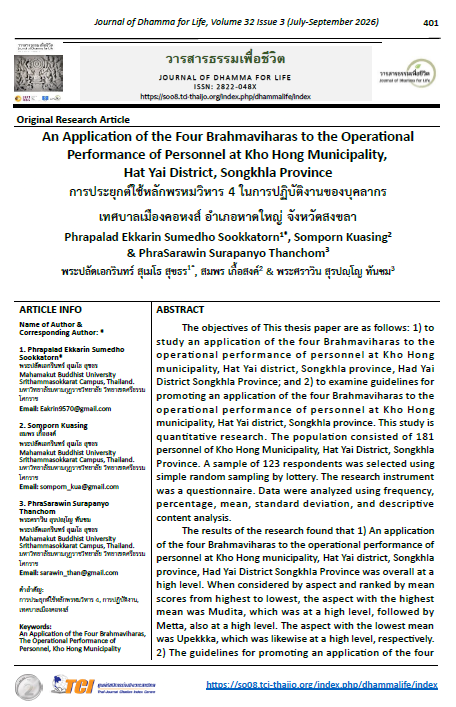
The objectives of This thesis paper are as follows: 1) to study an application of the four Brahmaviharas to the operational performance of personnel at Kho Hong municipality, Hat Yai district, Songkhla province, Had Yai District Songkhla Province; and 2) to examine guidelines for promoting an application of the four Brahmaviharas to the operational performance of personnel at Kho Hong municipality, Hat Yai district, Songkhla province. This study is quantitative research. The population consisted of 181 personnel of Kho Hong Municipality, Hat Yai District, Songkhla Province. A sample of 123 respondents was selected using simple random sampling by lottery. The research instrument was a questionnaire. Data were analyzed using frequency, percentage, mean, standard deviation, and descriptive content analysis.
The results of the research found that 1) An application of the four Brahmaviharas to the operational performance of personnel at Kho Hong municipality, Hat Yai district, Songkhla province, Had Yai District Songkhla Province was overall at a high level. When considered by aspect and ranked by mean scores from highest to lowest, the aspect with the highest mean was Mudita, which was at a high level, followed by Metta, also at a high level. The aspect with the lowest mean was Upekkka, which was likewise at a high level, respectively. 2) The guidelines for promoting an application of the four Brahmaviharas to the operational performance of personnel at Kho Hong municipality, Hat Yai district, Songkhla province, Hat Yai District Songkhla Province include prioritizing tasks and completing urgent work first; applying rational principles and relying primarily on factual evidence; cultivating a sense of mutual assistance in the workplace; consulting and discussing when problems arise; and organizing activities that promote unity within the organization. In addition, expressions of congratulations, praise, and encouragement should be given when work performance improves or achievements are attained. The organization should also establish clear and definite criteria for promotion, avoiding arbitrary decisions. Furthermore, fairness should be provided equally to all personnel, with impartiality maintained by not favoring one’s own group or wrongdoers, adhering strictly to rules and regulations, and imposing disciplinary actions on those who commit violations.
Article Details
References
บุญชม ศรีสะอาด. (2553). การวิจัยเบื้องต้น. กรุงเทพฯ: สุวีริยาสาส์น.
ดวงใจ กรายแก้ว. (2567). การใช้หลักพรหมวิหาร 4 ในการบริหารของผู้บริหารเทศบาลตำบลเขาพระ อำเภอพิปูน จังหวัดนครศรีธรรมราช. วารสารมหาจุฬานาครทรรศน์, 11(5), 70-78.
เทศบาลเมืองคอหงส์. (2568). ข้อมูลจำนวนบุคลากรเทศบาลเมืองคอหงส์ ณ วันที่ 1 ตุลาคม 2568. สงขลา: เทศบาลเมืองคอหงส์.
ปรัชญา หนูปลอด, & พระครูวุฒิชัยการโกศล. (2566). พรหมวิหาร 4: เข็มทิศนำทางสู่การบริหารบุคลากรอย่างยั่งยืน. วารสารการบริหารการศึกษา.
พระธรรมปิฎก (ป.อ. ปยุตฺโต). (2546). พุทธธรรม (ฉบับปรับปรุง). กรุงเทพฯ: มหาจุฬาลงกรณราชวิทยาลัย.
พระพรหมคุณาภรณ์ (ป.อ. ปยุตฺโต). (2559). พจนานุกรมพุทธศาสตร์ ฉบับประมวลธรรม. กรุงเทพฯ: ผลิธัมม์.
พระเจษฎาพงศ์ จรณธมฺโม, พระครูพิศาลสารบัณฑิต, & สมเดช นามเกตุ. (2565). การประยุกต์ใช้หลักพรหมวิหาร 4 เพื่อพัฒนาบุคลากร. วารสารพุทธศาสตร์ มจร.อุบลราชธานี.
พระพินิจ วิสุทฺโธ, & พระครูกิตติวราทร. (2564). การมีส่วนร่วมของประชาชนต่อการบริหารงานท้องถิ่นตามหลักพรหมวิหาร 4. วารสารพุทธปรัชญาวิวัฒน์.
พระประจักร กิตฺติโสภโณ (สามารถ). (2567). การประยุกต์ใช้หลักพรหมวิหาร 4 ในการปฏิบัติงานของ บุคลากรองค์กรปกครองส่วนท้องถิ่น อำเภอกุดชุม จังหวัดยโสธร, วารสารพุทธปรัชญาวิวัฒน์, 8(2), 500-511.
พรทิพย์ อนุพัฒน์, สันติ อุนจะนำ, & พระครูสิริธรรมาภิรัต. (2562). พรหมวิหาร 4 กับการบริหารงานบุคคลในองค์กร. วารสารศึกษาศาสตร์ มมร.
พระครูวิจิตรสาธุรส. (2560). การใช้หลักพรหมวิหารธรรมในการบริหารงานของผู้บริหารสถานศึกษาตาม ทัศนะของครูกลุ่มโรงเรียนการกุศล จังหวัดสงขลา. วารสารมหาจุฬานาครทรรศน์. 4 (1), 1-15.
ศุภกิตติ์ เต็มสงสัย. (2569). กลยุทธ์การบริหารงานบุคคลตามหลักพรหมวิหาร 4. วารสารศรีสุวรรณภูมิปริทรรศน์.
สมพร เทพสิทธา. (2550). คุณธรรมและจริยธรรมของข้าราชการ บทบาทของข้าราชการ. กรุงเทพมหานคร : สภาสังคมสงเคราะห์แห่งประเทศไทย.
สุพรรณา ภัทรเมธาวรกุล, วิทยาธร ท่อแก้ว และกรกช ขันธบุญ. (2565). การสื่อสารเพื่อการบริหารงานเชิง พุทธด้วยผู้นำ. วารสาร มจร สังคมศาสตร์ปริทรรศน์, 11(5), R116-R130.
Ansell, C., & Gash, A. (2008). Collaborative governance in theory and practice. Journal of Public Administration Research and Theory, 18(4), 543–571.
Cronbach, L. J. (1951). Coefficient alpha and the internal structure of tests. Psychometrika, 16(3), 297–334. https://doi.org/10.1007/BF02310555
Greenberg, J. (1987). A taxonomy of organizational justice theories. Academy of Management Review, 12(1), 9–22.
Herzberg, F. (1959). The motivation to work. New York: John Wiley & Sons.
Krejcie, R. V., & Morgan, D. W. (1970). Determining sample size for research activities. Educational and Psychological Measurement, 30(3), 607–610. https://doi.org/10. 1177/0013164470 03000308
Likert, R. (1932). A technique for the measurement of attitudes. Archives of Psychology, 140, 1–55.
Meyer, J. P., & Allen, N. J. (1991). A three-component conceptualization of organizational commitment. Human Resource Management Review, 1(1), 61–89.
Pfeffer, J., & Sutton, R. I. (2006). Hard facts, dangerous half-truths, and total nonsense: Profiting from evidence-based management. Boston, MA: Harvard Business School Press.
United Nations Development Programme (UNDP). (1997). Governance for sustainable human development. New York: UNDP.
World Bank. (1992). Governance and development. Washington, DC: World Bank.
