
Legal Issues Concerning The Submission Of Cases To The Court For The Enforcement Of Security Interests
Article Sidebar
Main Article Content
Abstract
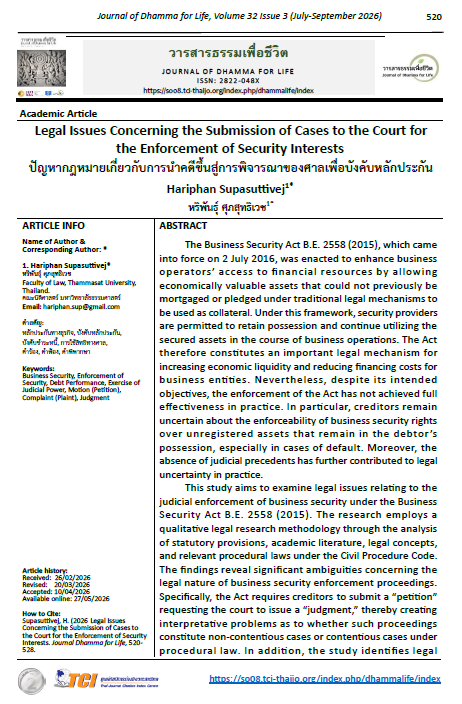
The Business Security Act B.E. 2558 (2015), which came into force on 2 July 2016, was enacted to enhance business operators’ access to financial resources by allowing economically valuable assets that could not previously be mortgaged or pledged under traditional legal mechanisms to be used as collateral. Under this framework, security providers are permitted to retain possession and continue utilizing the secured assets in the course of business operations. The Act therefore constitutes an important legal mechanism for increasing economic liquidity and reducing financing costs for business entities. Nevertheless, despite its intended objectives, the enforcement of the Act has not achieved full effectiveness in practice. In particular, creditors remain uncertain about the enforceability of business security rights over unregistered assets that remain in the debtor’s possession, especially in cases of default. Moreover, the absence of judicial precedents has further contributed to legal uncertainty in practice.
This study aims to examine legal issues relating to the judicial enforcement of business security under the Business Security Act B.E. 2558 (2015). The research employs a qualitative legal research methodology through the analysis of statutory provisions, academic literature, legal concepts, and relevant procedural laws under the Civil Procedure Code. The findings reveal significant ambiguities concerning the legal nature of business security enforcement proceedings. Specifically, the Act requires creditors to submit a “petition” requesting the court to issue a “judgment,” thereby creating interpretative problems as to whether such proceedings constitute non-contentious cases or contentious cases under procedural law. In addition, the study identifies legal uncertainties regarding whether creditors may simultaneously initiate claims for debt enforcement and security enforcement within the same action, as well as issues concerning the determination of court fees, which differ between contentious and non-contentious proceedings. The study contributes new knowledge by highlighting structural gaps in procedural mechanisms governing business security enforcement and demonstrating how such ambiguities undermine the effectiveness of the business security system and creditors’ confidence in secured transactions. The research proposes legal and procedural reforms to clarify the nature of enforcement proceedings and establish consistent judicial standards for interpretation and application. These reforms would enhance legal certainty, strengthen confidence among financial institutions, and improve access to finance, thereby contributing to sustainable economic development.
Article Details
References
กำชัย จงจักรพันธ์. (2559). เรื่องน่ารู้เกี่ยวกับกฎหมายหลักประกันทางธุรกิจ (พิมพ์ครั้งที่ 2). บริษัท ศรีอนันต์การพิมพ์ จำกัด.
ไพโรจน์ วายุภาพ. (2559). คำอธิบายกฎหมายวิธีพิจารณาความแพ่ง ภาค 1 บททั่วไป (พิมพ์ครั้งที่ 4). บริษัท กรุงสยาม พับลิชชิ่ง จำกัด.
ปัญญา ถนอมรอด. (2562). คำอธิบายประมวลกฎหมายแพ่งและพาณิชย์ ว่าด้วย ยืม ค้ำประกัน จำนอง จำนำ (พิมพ์ครั้งที่ 14). สำนักงานอบรมศึกษากฎหมายแห่งเนติบัณฑิตยสภา.
ยุพยงค์ วิงวร, & กรรณิภา วาณิชสุวรรณ. (2025). การวิเคราะห์มาตรา 41 แห่งพระราชบัญญัติหลักประกันสุขภาพแห่งชาติ พ.ศ. 2545: บทบาทและข้อจำกัดในการเยียวยาความเสียหายจากการรับบริการสาธารณสุข. วารสารสังคมพัฒนศาสตร์, 8(7), 92–104.
ยสวดี โค้คา (2527). การบังคับหลักประกันธุรกิจกรณีสิทธิเรียกร้องตามพระราชบัญญัติหลักประกันทางธุรกิจ พ.ศ. 2558 (วิทยานิพนธ์ปริญญาเอก, มหาวิทยาลัยสุโขทัยธรรมาธิราช).
เทพารักษ์, & บุณฑริกา. (2020). ปัญหาและอุปสรรคทางกฎหมายเกี่ยวกับการนำกิจการมาเป็นหลักประกันทางธุรกิจตามพระราชบัญญัติหลักประกันทางธุรกิจ พ.ศ. 2558.
สำนักงานคณะกรรมการกฤษฎีกา. (2558). หมายเหตุท้ายพระราชบัญญัติหลักประกันทางธุรกิจ พ.ศ. 2558. กรุงเทพฯ: สำนักงานคณะกรรมการกฤษฎีกา.
สุภธิดา สุกใส, & กิตติพศ สุกใส. (2562). การเปลี่ยนแปลงของกฎหมายบังคับตามคำพิพากษาหรือคำสั่งในคดีแพ่ง. CMU Journal of Law and Social Sciences, 12(1), 1–25.
Thawitsang, R., & Lamlert, W. (2020). Security problems under the Business Security Act B.E. 2558. Rajapark Journal, 14(33), 270–285.
United Nations Commission on International Trade Law. (2007). UNCITRAL legislative guide on secured transactions. United Nations.
White, J. J., & summers, R. S. (2000). Uniform Commercial Code (5th ed.). Hornbook Series.
