
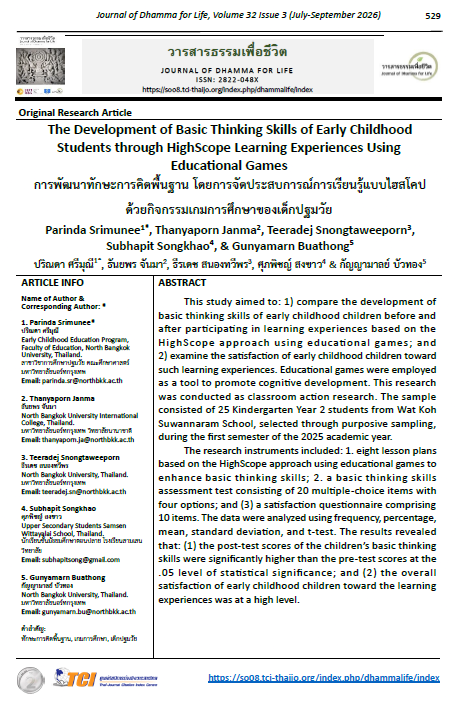
The Development of Basic Thinking Skills of Early Childhood Students through HighScope Learning Experiences Using Educational Games
Article Sidebar
Main Article Content
Abstract
This study aimed to: 1) compare the development of basic thinking skills of early childhood children before and after participating in learning experiences based on the HighScope approach using educational games; and 2) examine the satisfaction of early childhood children toward such learning experiences. Educational games were employed as a tool to promote cognitive development. This research was conducted as classroom action research. The sample consisted of 25 Kindergarten Year 2 students from Wat Koh Suwannaram School, selected through purposive sampling, during the first semester of the 2025 academic year.
The research instruments included: 1. eight lesson plans based on the HighScope approach using educational games to enhance basic thinking skills; 2. a basic thinking skills assessment test consisting of 20 multiple-choice items with four options; and (3) a satisfaction questionnaire comprising 10 items. The data were analyzed using frequency, percentage, mean, standard deviation, and t-test. The results revealed that: (1) the post-test scores of the children’s basic thinking skills were significantly higher than the pre-test scores at the .05 level of statistical significance; and (2) the overall satisfaction of early childhood children toward the learning experiences was at a high level.
Article Details
References
กระทรวงศึกษาธิการ. (2560). หลักสูตรการศึกษาปฐมวัย พุทธศักราช 2560. กรุงเทพมหานคร: กระทรวงศึกษาธิการ.
ธัญวดี กำจัดภัย. (2559). การพัฒนาผลสัมฤทธิ์ทางการเรียนด้วยเทคนิคการจัดการเรียนรู้โดยใช้เกมเป็นฐาน เรื่อง โครงสร้างระบบเครือข่าย สำหรับนักเรียนชั้นมัธยมศึกษาปีที่ 6. [วิทยานิพนธ์ปริญญามหาบัณฑิต, มหาวิทยาลัยราชภัฏ].
ธิดารัตน์ เอี่ยมคำ. (2568). การพัฒนาการจัดการเรียนรู้โดยใช้เกมเป็นฐาน หน่วยการเรียนรู้การใช้เทคโนโลยีในการแก้ปัญหา ชั้นมัธยมศึกษาปีที่ 2. [วิทยานิพนธ์ปริญญามหาบัณฑิต].
บุญชู สนั่นเสียง. (2527). เกมการศึกษา. กรุงเทพฯ: มหาวิทยาลัยศรีนครินทรวิโรฒ ประสานมิตร.
มูลคำ, สุวิทย์. (2551). กลยุทธ์การสอนคิดวิเคราะห์. กรุงเทพฯ: ภาพพิมพ์.
วรรณี วัจนสวัสดิ์. (2552). การพัฒนาเด็กปฐมวัย. กรุงเทพมหานคร: สำนักพิมพ์ที่จัดพิมพ์.
วัทนพร บุญชู. (2566). การพัฒนาผลสัมฤทธิ์และแรงจูงใจในการเรียนรู้ เรื่อง ประโยค โดยใช้การจัดการเรียนรู้ด้วยเทคนิคเกมมิฟิเคชันสำหรับนักเรียนชั้นประถมศึกษาปีที่ 2. [วิทยานิพนธ์ปริญญามหาบัณฑิต].
วิหะกะรัตน์, อรปรียา. (2555). การจัดการเรียนรู้ตามแนวคิดไฮสโคปสำหรับเด็กปฐมวัย. กรุงเทพฯ: สำนักพิมพ์แห่งจุฬาลงกรณ์มหาวิทยาลัย.
สำนวน คุณพล. (2547). การจัดการเรียนรู้โดยใช้เกมเป็นฐานเพื่อพัฒนาผลสัมฤทธิ์ทางการเรียนวิชาคณิตศาสตร์ ของนักเรียนชั้นมัธยมศึกษาปีที่ 1 [วิทยานิพนธ์/รายงานการวิจัย]. ชื่อสถาบันการศึกษา.
อารมณ์ สุวรรณปาล. (2551). เกมการศึกษาเพื่อพัฒนาเด็กปฐมวัย. กรุงเทพฯ: สำนักพิมพ์แห่ง จุฬาลงกรณ์มหาวิทยาลัย.
เยาวพา เดชะคุปต์. (2542). การจัดการศึกษาสำหรับเด็กปฐมวัย. กรุงเทพฯ: เอ.พี. กราฟฟิค ดีไซน์.
Bloom, B. S. (1964). Stability and change in human characteristics. New York, NY: John Wiley & Sons.
Hohmann, M., & Weikart, D. P. (1995). Educating young children: Active learning practices for preschool and child care programs. Ypsilanti, MI: High/Scope Press.
