Healthy Bakery: Business Opportunities and Challenges
Article Sidebar
Main Article Content
Abstract
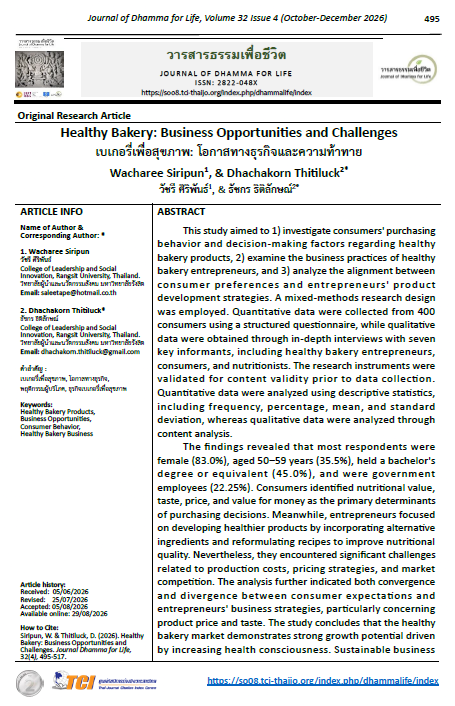
This study aimed to 1) investigate consumers' purchasing behavior and decision-making factors regarding healthy bakery products, 2) examine the business practices of healthy bakery entrepreneurs, and 3) analyze the alignment between consumer preferences and entrepreneurs' product development strategies. A mixed-methods research design was employed. Quantitative data were collected from 400 consumers using a structured questionnaire, while qualitative data were obtained through in-depth interviews with seven key informants, including healthy bakery entrepreneurs, consumers, and nutritionists. The research instruments were validated for content validity prior to data collection. Quantitative data were analyzed using descriptive statistics, including frequency, percentage, mean, and standard deviation, whereas qualitative data were analyzed through content analysis.
The findings revealed that most respondents were female (83.0%), aged 50–59 years (35.5%), held a bachelor's degree or equivalent (45.0%), and were government employees (22.25%). Consumers identified nutritional value, taste, price, and value for money as the primary determinants of purchasing decisions. Meanwhile, entrepreneurs focused on developing healthier products by incorporating alternative ingredients and reformulating recipes to improve nutritional quality. Nevertheless, they encountered significant challenges related to production costs, pricing strategies, and market competition. The analysis further indicated both convergence and divergence between consumer expectations and entrepreneurs' business strategies, particularly concerning product price and taste. The study concludes that the healthy bakery market demonstrates strong growth potential driven by increasing health consciousness. Sustainable business success depends on balancing nutritional quality, sensory appeal, affordability, and consumer satisfaction to enhance competitiveness and support long-term business growth.
Article Details
References
กรุงเทพธุรกิจ. (2568). แนวโน้มตลาดอาหารสุขภาพหลังโควิด-19 กับพฤติกรรมผู้บริโภคยุคใหม่. กรุงเทพธุรกิจ.
กนกวรรณ คงธนาคมธัญกิจ. (2563). ปัจจัยที่ส่งผลต่อการเลือกซื้ออาหารเพื่อสุขภาพในรูปแบบ พร้อมทานของผู้บริโภคในเขตกรุงเทพมหานคร. วิทยานิพนธ์ปริญญามหาบัณฑิต. มหาวิทยาลัยธรรมศาสตร์.
สำนักสารนิเทศ กระทรวงสาธารณสุข. (2567). สถานการณ์โรคเบาหวานในประเทศไทยและแนวโน้มการเพิ่มขึ้นของผู้ป่วยโรคไม่ติดต่อเรื้อรัง. กระทรวงสาธารณสุข.
สำนักงานพัฒนาวิทยาศาสตร์และเทคโนโลยีแห่งชาติ (สวทช.). (2562). นวัตกรรมอาหารเพื่อสุขภาพและวัตถุดิบทางเลือกสำหรับผู้บริโภคยุคใหม่. สำนักงานพัฒนาวิทยาศาสตร์และเทคโนโลยีแห่งชาติ.
Aaker, D. A. (1996). Building strong brands. Free Press.
Food and Agriculture Organization of the United Nations. (2018). Sustainable food systems: Concept and framework. FAO. https://www.fao.org
Food Focus Thailand. (2023). Trends in the bakery and health food market in Thailand. Food Focus Thailand.
Holbrook, M. B. (1999). Consumer value: A framework for analysis and research. Routledge.
International Diabetes Federation. (2023). IDF Diabetes Atlas (10th ed.): Global diabetes data and statistics. International Diabetes Federation.
Kotler, P., Armstrong, G., Harris, L. C., & He, H. (2017). Principles of marketing (7th European ed.). Pearson Education.
Kotler, P., & Keller, K. L. (2016). Marketing management (15th ed.). Pearson Education.
Peattie, K., & Crane, A. (2005). Green marketing: Legend, myth, farce or prophesy? Qualitative Market Research: An International Journal, 8(4), 357–370. https://doi.org/10.1108 /13522750510619733
Popkin, B. M., & Hawkes, C. (2016). Sweetening of the global diet, particularly beverages: Patterns, trends, and policy responses. The Lancet Diabetes & Endocrinology, 4(2), 174–186. https://doi.org/10.1016/S2213-8587(15)00419-2
Porter, M. E. (1990). The competitive advantage of nations. Free Press.
Schiffman, L. G., & Kanuk, L. L. (2010). Consumer behavior (10th ed.). Pearson Education.
World Health Organization. (2021). Noncommunicable diseases: Key facts. World Health Organization.
