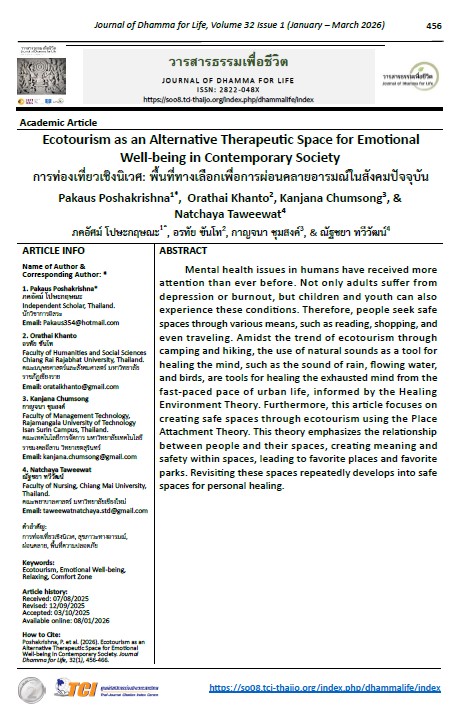
Ecotourism as an Alternative Therapeutic Space for Emotional Well-being in Contemporary Society
Article Sidebar
Main Article Content
Abstract
Mental health issues in humans have received more attention than ever before. Not only adults suffer from depression or burnout, but children and youth can also experience these conditions. Therefore, people seek safe spaces through various means, such as reading, shopping, and even traveling. Amidst the trend of ecotourism through camping and hiking, the use of natural sounds as a tool for healing the mind, such as the sound of rain, flowing water, and birds, are tools for healing the exhausted mind from the fast-paced pace of urban life, informed by the Healing Environment Theory. Furthermore, this article focuses on creating safe spaces through ecotourism using the Place Attachment Theory. This theory emphasizes the relationship between people and their spaces, creating meaning and safety within spaces, leading to favorite places and favorite parks. Revisiting these spaces repeatedly develops into safe spaces for personal healing.
Article Details
References
กุลแก้ว คล้ายแก้ว และคณิต เขียววิชัย. (2566). การท่องเที่ยวแกลมปิ้ง: มิติใหม่ของการพัฒนาการท่องเที่ยวหลังสถานการณ์โควิด-19. วารสารเพื่อการพัฒนาการท่องเที่ยวสู่ความยั่งยืน, 5(2), 83–96.
คณิน จินตนาปราโมทย์ และพรชัย สิทธิศรัณย์กุล. (2562). สรีรวิทยาความเครียดจากการทำงานและการแก้ปัญหาเมื่อเผชิญความเครียดในอาชีพแพทย์. วารสารการแพทย์และวิทยาศาสตร์สุขภาพ, 26(2), 112–123.
ชาตรี พงษ์พันธ์ และคณะ. (2567). แนวทางการจัดการสุขภาพชุมชนช่วงอุทกภัยสำหรับกลุ่มเปราะบาง: กรณีศึกษาตำบลหนองบ่อ จังหวัดอุบลราชธานี. วารสารสิ่งแวดล้อมศึกษาการแพทย์และสุขภาพ, 9(4), 712–719.
ณัฏฐพงษ์ ฉายแสงประทีป. (2557). รูปแบบและกระบวนการดำเนินธุรกิจการท่องเที่ยวเชิงเกษตร. วารสารวิชาการ Veridian E-Journal, 7(3), 310–321.
นพรัตน์ ศรีขาว. (2564). ความชุกและปัจจัยที่เกี่ยวข้องกับภาวะซึมเศร้าในเด็กโรคสมาธิสั้น. วารสารกุมารเวชศาสตร์, 60(4), 270–278.
บุญหลิบ ตั้งพานิชชาติ และรชพร จันทร์สว่าง. (2561). ความเป็นมาของอุตสาหกรรมท่องเที่ยว. ใน ความรู้เบื้องต้นเกี่ยวกับการท่องเที่ยวและอุตสาหกรรมท่องเที่ยว(2–30). สำนักพิมพ์มหาวิทยาลัยสุโขทัยธรรมาธิราช.
รชพร จันทร์สว่าง และคณะ. (2565). การท่องเที่ยวอาบป่า: ความหมาย คุณค่า และประโยชน์ในบริบทของประเทศไทย. ศิลปศาสตร์ปริทัศน์, 17(2), 80–96.
วรวรรณ จุฑา และคณะ. (2568). อัตราป่วยรายใหม่และความชุกโรคซึมเศร้าในคนไทยอายุ 15 ปีขึ้นไป ปี พ.ศ. 2565–2567: Health Data Center (HDC) คลังความรู้สุขภาพจิต กรมสุขภาพจิต. [ออนไลน์]. สืบค้นจาก https://dmh-elibrary.org/items/show/1807 (13 กันยายน 2568)
ศากุล ช่างไม้ และคณะ. (2559). คุณภาพชีวิต ความเครียด และภาวะซึมเศร้าในผู้สูงอายุที่ประสบมหาอุทกภัย ปี 2554. วารสารพยาบาล, 61(4), 1–9.
สำนักงานกองทุนสนับสนุนการสร้างเสริมสุขภาพ. (2563). ระบบนิเวศบำบัดที่ดี ภูมิคุ้มกัน ภาวะเครียด–ซึมเศร้าชั้นดี. [ออนไลน์]. สืบค้นจาก https://resourcecenter.thaihealth.or.th/content/273-content (13 กันยายน 2568)
Altman, I., & Low, S. M. (2012). Place attachment. Springer Science & Business Media.
Erdoğan, E. G., & Mersin, S. (2025). The relationship between the level of satisfaction of Maslow’s hierarchy of needs and loneliness, happiness and life satisfaction in elderly individuals. Journal of Clinical Nursing, 36(6), 1–21.
Lakkhana, S. (2021). Social media detox or digital detox. Journal of Educational Administration and Supervision, Mahasarakham University, 12(1), 7–15.
Miyazaki, Y. (2018). Shinrin-yoku: The Japanese art of forest bathing. Timber Press.
Natchanon, M., Reungrong, V. E., Kullaya, P., & Somboon, J. (2020). The influences of stress on depressive moods: The moderating effects of peer support and self-efficacy. Journal of Humanities and Social Sciences Valaya Alongkorn, 15(2), 63–82.
Poshakrishna, P. (2023). The effect of globalization on local culture in rural society. MCU Haripunchai Review, 7(3), 205–216.
Poshakrishna, P., & Akeugkahraraunnyarrath, N. (2023). Corporate social responsibility through social media in the tourism industry. Ratanabuth Journal, 5(1), 588–604.
Ulrich, R. (1984). View through a window may influence recovery from surgery. Science, 224(4647), 420–421.
Ulrich, R. S., Simons, R. F., Losito, B. D., Fiorito, E., Miles, M. A., & Zelson, M. (1991). Stress recovery during exposure to natural and urban environments. Journal of Environmental Psychology, 11(3), 201–230.
Warach, M. (2019). Structure of tourism system. Journal of Thai Hospitality & Tourism, 14(1), 94–102.
Yoosuk, P., & Pholprasert, A. (2023). Natural sound integrated art activities to promote environmental appreciation for youth. Journal of Social Science and Cultural, 7(9), 271–281.
