An Analystical Study of the 5 Gati Affecting the Way of Life of Thai People in the Modern Society
Article Sidebar
Main Article Content
Abstract
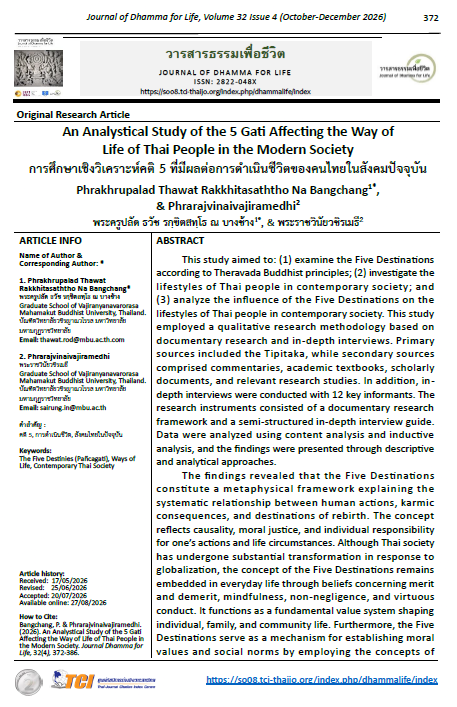
This study aimed to: (1) examine the Five Destinations according to Theravada Buddhist principles; (2) investigate the lifestyles of Thai people in contemporary society; and (3) analyze the influence of the Five Destinations on the lifestyles of Thai people in contemporary society. This study employed a qualitative research methodology based on documentary research and in-depth interviews. Primary sources included the Tipitaka, while secondary sources comprised commentaries, academic textbooks, scholarly documents, and relevant research studies. In addition, in-depth interviews were conducted with 12 key informants. The research instruments consisted of a documentary research framework and a semi-structured in-depth interview guide. Data were analyzed using content analysis and inductive analysis, and the findings were presented through descriptive and analytical approaches.
The findings revealed that the Five Destinations constitute a metaphysical framework explaining the systematic relationship between human actions, karmic consequences, and destinations of rebirth. The concept reflects causality, moral justice, and individual responsibility for one’s actions and life circumstances. Although Thai society has undergone substantial transformation in response to globalization, the concept of the Five Destinations remains embedded in everyday life through beliefs concerning merit and demerit, mindfulness, non-negligence, and virtuous conduct. It functions as a fundamental value system shaping individual, family, and community life. Furthermore, the Five Destinations serve as a mechanism for establishing moral values and social norms by employing the concepts of fortunate and unfortunate destinations as frameworks for evaluating human behavior. These principles encourage honesty, compassion, and personal responsibility, thereby contributing to peaceful coexistence and the improvement of quality of life in Thai society.
Article Details
References
ไตรภูมิพระร่วง. (2544). ไตรภูมิพระร่วง. กรุงเทพฯ: กรมศิลปากร.
พระมหาพิเชษฐ์ ธีรวํโส (ดอกรัก). (2534). การศึกษาเชิงวิเคราะห์เรื่องกรรมและสังสารวัฏในพุทธเถรวาทที่มีผลต่อการดำเนินชีวิตของพุทธศาสนิกชนไทยในปัจจุบัน (วิทยานิพนธ์ปริญญามหาบัณฑิต). กรุงเทพฯ: มหาวิทยาลัยมหาจุฬาลงกรณราชวิทยาลัย.
พระมหารบ ธมฺมธโร (หิรัญชาติ). (2547). มโนทัศน์เรื่องการตายและเกิด (วิทยานิพนธ์ปริญญา มหาบัณฑิต). กรุงเทพฯ: มหาวิทยาลัยมหาจุฬาลงกรณราชวิทยาลัย.
พระมหาสมพงษ์ สุขุมาโล (สิงห์สุพรรณ). (2538). การศึกษาเชิงวิเคราะห์เรื่องสังสารวัฏในพุทธศาสนาเถรวาท. วิทยานิพนธ์ศาสนศาสตรมหาบัณฑิต, บัณฑิตวิทยาลัย สภาการศึกษามหามกุฏราชวิทยาลัย.
มหามกุฏราชวิทยาลัย. (2552). พระไตรปิฎก ฉบับมหามกุฏราชวิทยาลัย. กรุงเทพฯ: มหามกุฏราช วิทยาลัย.
วศิน อินทสระ. (2555). ความดีและอานุภาพแห่งความดี. กรุงเทพฯ: ธรรมดา.
สมเด็จพระพุทธโฆษาจารย์ (ป.อ.ปยุตฺโต). (2545). พุทธธรรม (ฉบับปรับปรุงและขยายความ). กรุงเทพฯ: มหาจุฬาลงกรณราชวิทยาลัย.
สมเด็จพระพุทธโฆษาจารย์ (ป.อ. ปยุตฺโต). (2564). พุทธธรรม ฉบับปรับขยาย (พิมพ์ครั้งที่ 56). กรุงเทพมหานคร: สหธรรมิก.
สมฤดี จันทร์กล่ำ. (2563). การดำเนินชีวิตตามหลักทิศ 6 ในพุทธปรัชญาเถรวาท (วิทยานิพนธ์). มหาวิทยาลัยมหาจุฬาลงกรณราชวิทยาลัย.
อัจฉรา ไชยราช. (2567). บูรณาการการดำเนินชีวิตที่ดีงามตามแนวพุทธปรัชญาเถรวาทของประชาชนจังหวัดร้อยเอ็ด (วิทยานิพนธ์). มหาวิทยาลัยมหาจุฬาลงกรณราชวิทยาลัย.
