Factors Affecting Organizational Commitment of Sales Employees in the Central Region a Case Study of a Private Company
Article Sidebar
Main Article Content
Abstract
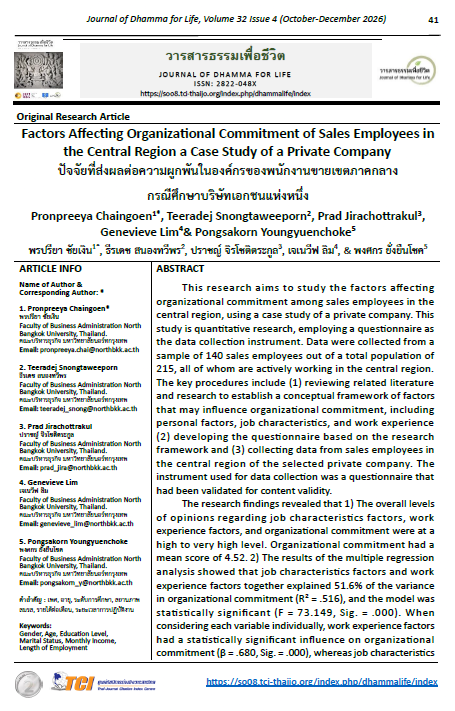
This research aims to study the factors affecting organizational commitment among sales employees in the central region, using a case study of a private company. This study is quantitative research, employing a questionnaire as the data collection instrument. Data were collected from a sample of 140 sales employees out of a total population of 215, all of whom are actively working in the central region. The key procedures include (1) reviewing related literature and research to establish a conceptual framework of factors that may influence organizational commitment, including personal factors, job characteristics, and work experience (2) developing the questionnaire based on the research framework and (3) collecting data from sales employees in the central region of the selected private company. The instrument used for data collection was a questionnaire that had been validated for content validity.
The research findings revealed that 1) The overall levels of opinions regarding job characteristics factors, work experience factors, and organizational commitment were at a high to very high level. Organizational commitment had a mean score of 4.52. 2) The results of the multiple regression analysis showed that job characteristics factors and work experience factors together explained 51.6% of the variance in organizational commitment (R² = .516), and the model was statistically significant (F = 73.149, Sig. = .000). When considering each variable individually, work experience factors had a statistically significant influence on organizational commitment (β = .680, Sig. = .000), whereas job characteristics factors were not found to have a statistically significant influence.
Article Details
References
กิตติพงษ์ สุขสมบัติ. (2562). ปัจจัยที่ส่งผลต่อความผูกพันในองค์การของพนักงานขายในธุรกิจค้าปลีกกรุงเทพมหานคร. มหาวิทยาลัยราชภัฏสวนสุนันทา.
ชุติมา ภักดีรักษ์. (2565). ปัจจัยด้านสภาพแวดล้อมในการทำงานที่มีผลต่อความผูกพันต่อองค์กรของพนักงานบริษัทเอกชนในประเทศไทย. วิทยานิพนธ์บริหารธุรกิจมหาบัณฑิต, มหาวิทยาลัยศรีปทุม.
ทิพาพร วงศ์ (สวัสดิ์). (2563). ความสัมพันธ์ระหว่างแรงจูงใจในการทำงานกับความผูกพันในองค์กรของพนักงานบริษัทเอกชน. วารสารวิจัยและพัฒนา มหาวิทยาลัยราชภัฏพระนคร, 15(2), 112–124.
พัชรี พรหมศรี. (2565). สภาพแวดล้อมในการทำงานกับความผูกพันในองค์กรของพนักงานธุรกิจวัสดุก่อสร้าง. วารสารบริหารธุรกิจและนวัตกรรม, 7(1), 88–99.
เพ็ญ นภา ทองคำ. (2567). ความสัมพันธ์ระหว่างความสุขในการทำงานกับความผูกพันต่อองค์กรของพนักงานพิเศษเงินรายได้ มหาวิทยาลัยเทคโนโลยีราชมงคลธัญบุรี. วารสารออนไลน์. https://so02. tcithaijo.org/index.php/JRKSA/article/view/273935
สุพัตรา จันทร์แก้ว. (2562). ปัจจัยที่ส่งผลต่อความผูกพันต่อองค์กรของพนักงานบริษัทเอกชนในเขตกรุงเทพมหานคร. การค้นคว้าอิสระบริหารธุรกิจมหาบัณฑิต, มหาวิทยาลัยรามคำแหง.
ศิริพร จันทรา. (2566). แรงจูงใจในการทำงานและความผูกพันต่อองค์กรของพนักงานขายผลิตภัณฑ์อุตสาห กรรมสี. วิทยานิพนธ์ปริญญามหาบัณฑิต, มหาวิทยาลัยเกษตรศาสตร์.
Blau, P. M. (1964). Exchange and power in social life. Wiley.
Cropanzano, R., & Mitchell, M. S. (2005). Social exchange theory: An interdisciplinary review. Journal of Management, 31(6), 874–900. https://doi.org/10.1177/0149206305279602
Daft, R. L. (2021). Organization theory and design (13th ed.). Cengage Learning.
Dessler, G. (2017). Human resource management (15th ed.). Pearson.
Hackman, J. R., & Oldham, G. R. (1976). Motivation through the design of work: Test of a theory. Organizational Behavior and Human Performance, 16(2), 250–279. https://doi.org/10. 1016/0030-5073(76)90016-7
Herzberg, F., Mausner, B., & Snyderman, B. B. (1959). The motivation to work (2nd ed.). Wiley.
Kolb, D. A. (1984). Experiential learning: Experience as the source of learning and development. Prentice-Hall.
Mathieu, J. E., & Zajac, D. M. (1990). A review and meta-analysis of the antecedents, correlates, and consequences of organizational commitment. Psychological Bulletin, 108(2), 171–194. https://doi.org/10.1037/0033-2909.108.2.171
Meyer, J. P., & Allen, N. J. (1991). A three-component conceptualization of organizational commitment. Human Resource Management Review, 1(1), 61–89. https://doi.org/10.1 016/1053-4822(91)90011-Z
Meyer, J. P., & Allen, N. J. (1991). A three-component conceptualization of organizational commitment. Journal of Vocational Behavior, 52(1), 61–89. https://doi.org/10.1016/ 0001-8791(91)90011-Z
Robbins, S. P., & Judge, T. A. (2023). Organizational behavior (19th ed.). Pearson.
