Comparative Analysis of the Law on Criminal Mediation With The Mediation Process of Monks
Article Sidebar
Main Article Content
Abstract
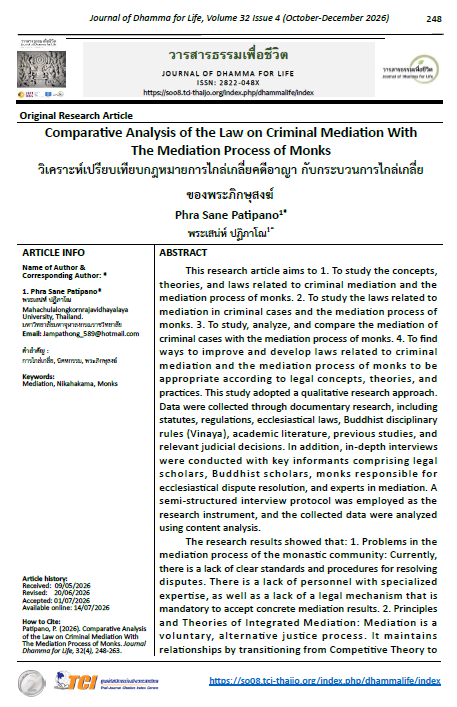
This research article aims to 1. To study the concepts, theories, and laws related to criminal mediation and the mediation process of monks. 2. To study the laws related to mediation in criminal cases and the mediation process of monks. 3. To study, analyze, and compare the mediation of criminal cases with the mediation process of monks. 4. To find ways to improve and develop laws related to criminal mediation and the mediation process of monks to be appropriate according to legal concepts, theories, and practices. This study adopted a qualitative research approach. Data were collected through documentary research, including statutes, regulations, ecclesiastical laws, Buddhist disciplinary rules (Vinaya), academic literature, previous studies, and relevant judicial decisions. In addition, in-depth interviews were conducted with key informants comprising legal scholars, Buddhist scholars, monks responsible for ecclesiastical dispute resolution, and experts in mediation. A semi-structured interview protocol was employed as the research instrument, and the collected data were analyzed using content analysis.
The research results showed that: 1. Problems in the mediation process of the monastic community: Currently, there is a lack of clear standards and procedures for resolving disputes. There is a lack of personnel with specialized expertise, as well as a lack of a legal mechanism that is mandatory to accept concrete mediation results. 2. Principles and Theories of Integrated Mediation: Mediation is a voluntary, alternative justice process. It maintains relationships by transitioning from Competitive Theory to Problem-Solving Theory and Conflict Theory to manage conflicts and bring about positive changes. 3. In terms of the potential of mediators: The monks who are in charge of resolving monastic offenses should be encouraged to be proficient in both civil law and the Vinaya (Book of Discipline), based on the principles of Adhikaraṇasamatha as the foundation, applied with mediation skills to be in line with the current social context. 4. Preparation of standards and supporting structures: A standard operating procedure (SOP) with clear procedures should be prepared, and a committee of qualified mediators should be appointed. 5. The proactive role of support agencies: The National Office of Buddhism should be the core of promoting knowledge, develop a mediator training course, and coordinate integration with judicial authorities to maximize the effectiveness of dispute resolution and mediation in the clergy.
Article Details
References
กิตติพงษ์ กิตยารักษ์ และคณะ. (2550). การไกล่เกลี่ยระงับข้อพิพาทและความขัดแย้งในชุมชน (พิมพ์ครั้งที่ 1). กรุงเทพฯ: สำนักพิมพ์ชุมนุมสหกรณ์การเกษตรแห่งประเทศไทย.
คชาภรณ์ คำสอนทา และคณะ. (2558). กระบวนการและขั้นตอนการระงับอธิกรณ์ในพระพุทธศาสนาเถรวาท. วารสารสันติศึกษาปริทรรศน์, 3(1), 74–75.
ชัย เลี้ยงบุญเลิศชัย. (2556). หลักการและแนวคิดในการไกล่เกลี่ยข้อพิพาท: ทนายความผู้ทำหน้าที่ไกล่เกลี่ยข้อพิพาท (พิมพ์ครั้งที่ 1). กรุงเทพฯ: ฝ่ายวิชาการสภาทนายความ.
ชลัท ประเทืองรัตนา. (2557). รูปแบบและกระบวนการยุติธรรมเชิงสมานฉันท์โดยใช้ครอบครัวและชุมชนเป็นฐาน: ศึกษากรณีศูนย์สันติวิธีสาธารณสุข (ดุษฎีนิพนธ์ปรัชญาดุษฎีบัณฑิต สาขาวิชาการบริหารกระบวนการยุติธรรม). คณะสังคมสงเคราะห์ศาสตร์ มหาวิทยาลัยธรรมศาสตร์.
ฐิติมา บุญประเสริฐ และคณะ. (2562). กระบวนการไกล่เกลี่ยข้อพิพาทตามพระราชบัญญัติการไกล่เกลี่ยข้อพิพาท พ.ศ. 2562: ศึกษาเฉพาะกรณีการไกล่เกลี่ยข้อพิพาททางอาญาในชั้นสอบสวน (วิทยานิพนธ์นิติศาสตรมหาบัณฑิต สาขาวิชานิติศาสตร์). คณะนิติศาสตร์ มหาวิทยาลัยศรีปทุม.
นันทวัน วงษ์สุภักดี. (2563). การไกล่เกลี่ยข้อพิพาททางอาญาในชั้นสอบสวน: ศึกษา พ.ร.บ.การไกล่เกลี่ยข้อพิพาท พ.ศ. 2562 (วิทยานิพนธ์นิติศาสตรมหาบัณฑิต สาขาวิชานิติศาสตร์). คณะนิติศาสตร์ปรีดี พนมยงค์ มหาวิทยาลัยธุรกิจบัณฑิตย์.
เนาวรัตน์ พลายร้อย และคณะ. (2562). รูปแบบการส่งเสริมการท่องเที่ยวเชิงสุขภาพ จังหวัดระนอง (รายงานการวิจัย). กรุงเทพฯ: สำนักงานคณะกรรมการส่งเสริมวิทยาศาสตร์ วิจัยและนวัตกรรม.
บุญยกาญจน์ อินทรบุตร. (2553). กระบวนการไกล่เกลี่ยข้อพิพาทโดยบุคคลภายนอกในคดีอาญา: ศึกษาเปรียบเทียบระหว่างประเทศไทยและประเทศสหรัฐอเมริกา (วิทยานิพนธ์นิติศาสตรมหาบัณฑิต สาขาวิชานิติศาสตร์). คณะนิติศาสตร์ มหาวิทยาลัยธรรมศาสตร์.
พระพรหมคุณาภรณ์ (ป.อ. ปยุตฺโต). (2546). พจนานุกรมพุทธศาสตร์ ฉบับประมวลธรรม. กรุงเทพฯ: มหาจุฬาลงกรณราชวิทยาลัย.
พระราชรัตนกวี (ไสว สุจิตฺโต). (2523). คำอธิบายกฎมหาเถรสมาคม ฉบับที่ 11 (พ.ศ. 2521) ว่าด้วยการลงนิคหกรรม ภาควิชาการและภาคปฏิบัติ พร้อมด้วยพระราชบัญญัติคณะสงฆ์ พ.ศ. 2505 และกฎมหาเถรสมาคม ฉบับที่ 11 (พิมพ์ครั้งที่ 1). กรุงเทพฯ: ธีรพงษ์การพิมพ์.
มหาวิทยาลัยมหาจุฬาลงกรณราชวิทยาลัย. (2539). พระไตรปิฎกภาษาไทย ฉบับมหาจุฬาลงกรณราชวิทยาลัย. กรุงเทพมหานคร: โรงพิมพ์มหาจุฬาลงกรณราชวิทยาลัย.
เสวก สุบรรณเกตุ. (2526). บทบัญญัติในพระราชบัญญัติคณะสงฆ์ พ.ศ. 2505 (วิทยานิพนธ์ศิลปศาสตรมหาบัณฑิต สาขาวิชาประวัติศาสตร์ไทย). บัณฑิตวิทยาลัย มหาวิทยาลัยศรีนครินทรวิโรฒ.
สรวิศ ลิมปรังษี. (2550). การไกล่เกลี่ยข้อพิพาทและการระงับข้อพิพาททางเลือก. กรุงเทพฯ: สำนักระงับข้อพิพาท สำนักงานศาลยุติธรรม.
อธิราช มณีภาค. (2546). การศึกษาเปรียบเทียบกระบวนการยุติธรรมในพระวินัยปิฎกกับกระบวนการยุติธรรมของกฎหมายไทย (วิทยานิพนธ์พุทธศาสตรมหาบัณฑิต สาขาวิชาพระพุทธศาสนา). บัณฑิตวิทยาลัย มหาวิทยาลัยมหาจุฬาลงกรณราชวิทยาลัย.
