
การศึกษาเปรียบเทียบความเหงาและปัจจัยที่เกี่ยวข้องก่อนและหลังการเลี้ยงแมว ของผู้พักอาศัยในเขตกรุงเทพมหานครและปริมณฑล
Article Sidebar
Main Article Content
บทคัดย่อ
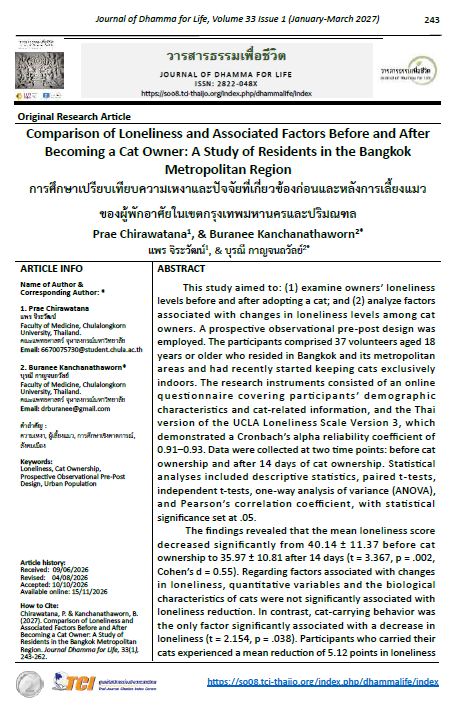
การวิจัยนี้มีวัตถุประสงค์เพื่อ 1) ศึกษาระดับความเหงาของผู้เลี้ยงในระยะก่อนและหลังการเลี้ยงแมว และ 2) วิเคราะห์ปัจจัยที่สัมพันธ์กับการเปลี่ยนแปลงระดับความเหงาของผู้เลี้ยงแมว ใช้รูปแบบการวิจัยเชิงวิเคราะห์แบบติดตามผลไปข้างหน้าและเปรียบเทียบก่อนและหลังในกลุ่มตัวอย่างเดียวกัน กลุ่มตัวอย่างเป็นอาสาสมัครอายุ 18 ปีขึ้นไป ซึ่งพักอาศัยในกรุงเทพมหานครและปริมณฑล และเริ่มต้นเลี้ยงแมวในระบบปิด จำนวน 37 ราย เครื่องมือวิจัยประกอบด้วยแบบสอบถามออนไลน์เกี่ยวกับข้อมูลส่วนบุคคลและข้อมูลเกี่ยวกับแมว และแบบวัดความเหงามาตรฐาน 3 ฉบับภาษาไทย ซึ่งมีค่าความเชื่อมั่น Cronbach’s alpha เท่ากับ 0.91–0.93 เก็บรวบรวมข้อมูล 2 ระยะ ได้แก่ ก่อนเริ่มเลี้ยงแมวและหลังเลี้ยงครบ 14 วัน วิเคราะห์ข้อมูลด้วยสถิติเชิงพรรณนา การทดสอบ Paired t-test, Independent t-test, One-way ANOVA และสัมประสิทธิ์สหสัมพันธ์ของเพียร์สัน โดยกำหนดระดับนัยสำคัญทางสถิติที่ .05
ผลการวิจัยพบว่า คะแนนความเหงาเฉลี่ยหลังการเลี้ยงแมวลดลงจาก 40.14 ± 11.37 เป็น 35.97 ± 10.81 อย่างมีนัยสำคัญทางสถิติ (t = 3.367, p = .002, Cohen’s d = 0.55) สำหรับปัจจัยที่สัมพันธ์กับการเปลี่ยนแปลงระดับความเหงา พบว่าตัวแปรเชิงปริมาณและลักษณะทางชีวภาพของแมวไม่มีความสัมพันธ์อย่างมีนัยสำคัญทางสถิติ ขณะที่พฤติกรรมการอุ้มแมวเป็นปัจจัยเดียวที่สัมพันธ์กับการลดลงของระดับความเหงาอย่างมีนัยสำคัญ (t = 2.154, p = .038) โดยกลุ่มที่อุ้มแมวมีคะแนนความเหงาลดลงเฉลี่ย 5.12 คะแนน ส่วนกลุ่มที่ไม่อุ้มแมวลดลงเฉลี่ย 1.20 คะแนน ผลการศึกษาสะท้อนว่าการเลี้ยงแมวในระยะเวลา 14 วันมีความสัมพันธ์กับการลดลงของระดับความเหงา และปฏิสัมพันธ์ทางกายภาพอย่างใกล้ชิด โดยเฉพาะการอุ้มแมว อาจเป็นองค์ประกอบสำคัญที่เกี่ยวข้องกับการเปลี่ยนแปลงดังกล่าว อย่างไรก็ตาม การขาดกลุ่มควบคุมและระยะเวลาติดตามผลที่จำกัดเป็นข้อจำกัดในการตีความผลเชิงเหตุและผล จึงควรมีการศึกษาเพิ่มเติมด้วยกลุ่มตัวอย่างขนาดใหญ่ขึ้น มีกลุ่มควบคุม และติดตามผลในระยะยาว
Article Details
เอกสารอ้างอิง
จริยา ปานเกษม, สาวิตรี อัษณางค์กรชัย, และ ทวีศิลป์ วิษณุโยธิน. (2564). การแปลและการตรวจสอบคุณสมบัติทางจิตมิติของแบบวัดความเหงา UCLA Loneliness Scale ฉบับภาษาไทย (เวอร์ชัน 3). วารสารสมาคมจิตแพทย์แห่งประเทศไทย, 66(3), 287–300.
ศูนย์วิจัยกสิกรไทย. (2569). เจาะเทรนด์ Cat Economy: ประชากรแมวในไทยพุ่งทะลุ 4 ล้านตัว สะท้อนไลฟ์สไตล์คนเมือง. สืบค้นเมื่อ 14 มิถุนายน 2569, จาก https://www.kasikornresearch.com
วศิกา กระเทศ. (2563). Pet Humanization ในสังคมไทย: พฤติกรรมและความสัมพันธ์ของผู้เลี้ยงสัตว์ในยุคดิจิทัล. วารสารสังคมศาสตร์และมนุษยศาสตร์, 46(2), 115–134.
Banks, M. R., & Banks, W. A. (2002). The effects of animal-assisted therapy on loneliness in an elderly population in long-term care facilities. The Journals of Gerontology Series A: Biological Sciences and Medical Sciences, 57(7), M428–M432. https://doi.org/10. 1093/gerona/57.7.M428
Bowlby, J. (1969). Attachment and loss: Vol. 1. Attachment. Basic Books.
Beetz, A., Uvnäs-Moberg, K., Julius, H., & Kotrschal, K. (2012). Psychosocial and psychophysiological effects of human-animal interactions: The possible role of oxytocin. Frontiers in Psychology, 3, Article 234. https://doi.org/10.3389/fpsyg.2012.00234
Biocca, F., Harms, C., & Burgoon, J. K. (2003). Toward a more robust theory and measure of social presence: Review and suggested criteria. Presence: Teleoperators and Virtual Environments, 12(5), 456–480. https://doi.org/10.1162/105474603322761270
Bir, C., Widmar, N. O., & Croney, C. (2017). A survey of dog acquisition and ownership patterns and owner attitudes toward dog ownership. Preventive Veterinary Medicine, 137, 46–53. https://doi.org/10.1016/j.prevetmed.2016.12.014
Fine, A. H. (Ed.). (2010). Handbook on animal-assisted therapy: Theoretical foundations and guidelines for practice (3rd ed.). Academic Press.
Fogelson, D. M., Rutledge, C., & Zimbro, K. S. (2021). The impact of robotic pet companionship on loneliness and morale in older adults diagnosed with dementia. Journal of Holistic Nursing, 39(1), 43–56. https://doi.org/10.1177/0898010120944139
Glocker, M. L., Langleben, D. D., Ruparel, K., Loughead, J. W., Gur, R. C., & Sachser, N. (2009). Baby schema in infant faces induces cuteness perception and motivation for caretaking in adults. Ethology, 115(3), 257–263. https://doi.org/10.1111/j.1439-0310.2008.01603.x
Hawkley, L. C., & Cacioppo, J. T. (2010). Loneliness matters: A theoretical and empirical review of consequences and mechanisms. Annals of Behavioral Medicine, 40(2), 218–227. https://doi.org/10.1007/s12160-010-9210-8
Kretzler, B., König, H.-H., & Hajek, A. (2022). Pet ownership, loneliness, and social isolation: A systematic review. Social Psychiatry and Psychiatric Epidemiology, 57(10), 1935–1957. https://doi.org/10.1007/s00127-022-02332-9
McConnell, A. R., Brown, C. M., Shoda, T. M., Stayton, L. E., & Martin, C. E. (2011). Friends with benefits: On the positive consequences of pet ownership. Journal of Personality and Social Psychology, 101(6), 1239–1252. https://doi.org/10.1037/a0024506
Nolen-Hoeksema, S. (2000). The role of rumination in depressive disorders and mixed anxiety/depressive symptoms. Journal of Abnormal Psychology, 109(3), 504–511. https://doi.org/10.1037/0021-843X.109.3.504
Perlman, D., & Peplau, L. A. (1982). Theoretical approaches to loneliness. In L. A. Peplau & D. Perlman (Eds.), Loneliness: A sourcebook of current theory, research and therapy (pp. 123–134). John Wiley & Sons.
Russell, D. W. (1996). UCLA Loneliness Scale (Version 3): Reliability, validity, and factor structure. Journal of Personality Assessment, 66(1), 20–40. https://doi.org/10.1207/ s15327752jpa6601_2
von Muggenthaler, E. (2001). The felid purr: A healing mechanism? Journal of the Acoustical Society of America, 110(5 Supplement), 2666. https://doi.org/10.1121/1.4777098
Weiss, R. S. (1973). Loneliness: The experience of emotional and social isolation. MIT Press.
Wilson, E. O. (1984). Biophilia. Harvard University Press.
Zasloff, R. L., & Kidd, A. H. (1994). Loneliness and pet ownership among single women. Psychological Reports, 75(2), 747–752. https://doi.org/10.2466/pr0.1994.75.2.747