An Analysis of Saddhā in Sacred Objects in the View of Buddhism in Contemporary Thai Society
Article Sidebar
Main Article Content
Abstract
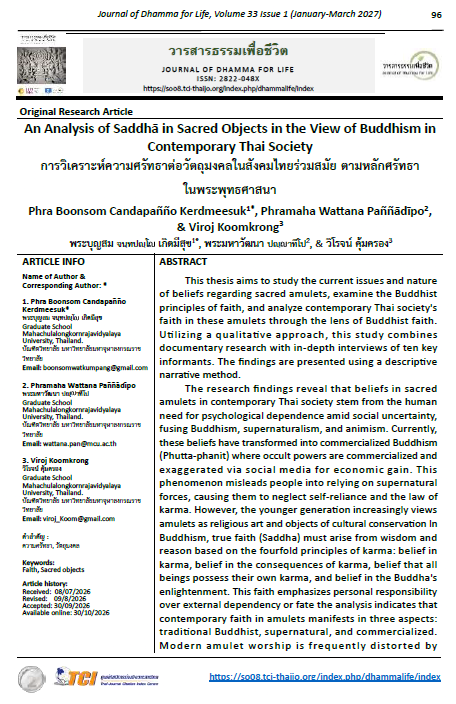
This thesis aims to study the current issues and nature of beliefs regarding sacred amulets, examine the Buddhist principles of faith, and analyze contemporary Thai society's faith in these amulets through the lens of Buddhist faith. Utilizing a qualitative approach, this study combines documentary research with in-depth interviews of ten key informants. The findings are presented using a descriptive narrative method.
The research findings reveal that beliefs in sacred amulets in contemporary Thai society stem from the human need for psychological dependence amid social uncertainty, fusing Buddhism, supernaturalism, and animism. Currently, these beliefs have transformed into commercialized Buddhism (Phutta-phanit) where occult powers are commercialized and exaggerated via social media for economic gain. This phenomenon misleads people into relying on supernatural forces, causing them to neglect self-reliance and the law of karma. However, the younger generation increasingly views amulets as religious art and objects of cultural conservation In Buddhism, true faith (Saddha) must arise from wisdom and reason based on the fourfold principles of karma: belief in karma, belief in the consequences of karma, belief that all beings possess their own karma, and belief in the Buddha's enlightenment. This faith emphasizes personal responsibility over external dependency or fate the analysis indicates that contemporary faith in amulets manifests in three aspects: traditional Buddhist, supernatural, and commercialized. Modern amulet worship is frequently distorted by commercialism and greed. Ultimately, sacred amulets and supernatural phenomena are merely preliminary skillful means (Upaya) and mental anchors, not the ultimate goal of Buddhism. Practitioners must exercise wisdom to avoid falling victim to commercial schemes, utilizing amulets solely as reminders to practice morality, maintain precepts, and rely on the law of karma for sustainable happiness.
Article Details
References
จรัส พยัคฆราชศักดิ์. (2538). เอกสารการสอนไทยคตีศึกษา ศาสนา และลัทธิในท้องถิ่น มหาสารคาม. ปรีดาการพิมพ์.
จิราภรณ์ ภัทราภานุภัทร. (2528). สถานภาพการศึกษาเรื่องคติความเชื่อของไทย. จุฬาลงกรณ์มหาวิทยาลัย.
เดือน คำดี. (2541). ศาสนศาสตร์. สำนักพิมพ์มหาวิทยาลัยเกษตรศาสตร์.
ทรงพล ภูมิพัฒน์. (2541). จิตวิทยาสังคม (พิมพ์ครั้งที่ 2). มหาวิทยาลัยศรีปทุม.
เทพย์ สาริกบุตร. (2503). พุทธาภิเษกพิธี. อุตสาหกรรมการพิมพ์.
ป. รัตนปัญญา. (2528). สอนเด็กไม่ให้เชื่อโชคลางของขลัง. โอเดียนสโตร์.
ประเทิน มหาขันธ์. (2534). ศิลปะการสักลาย. โอ.เอส. พริ้นติ้ง เฮ้าส์.
ปิ่น มุทุกันต์. (2537). มงคลชีวิต (พิมพ์ครั้งที่ 5). สำนักพิมพ์คลังพิทยา.
พงศ์พันธุ์ รัตนกุล. (2563). ศรัทธาและความเชื่อในพระเครื่อง: พลังทางจิตวิญญาณในชีวิตประจำวัน. มหาวิทยาลัยมหาจุฬาลงกรณราชวิทยาลัย.