Interpersonal Skills Based on the Four Brahmavihara Principles of School Administrators Affecting Personnel Management in Schools under the Secondary Educational Service Area Office Suphanburi
Article Sidebar
Main Article Content
Abstract
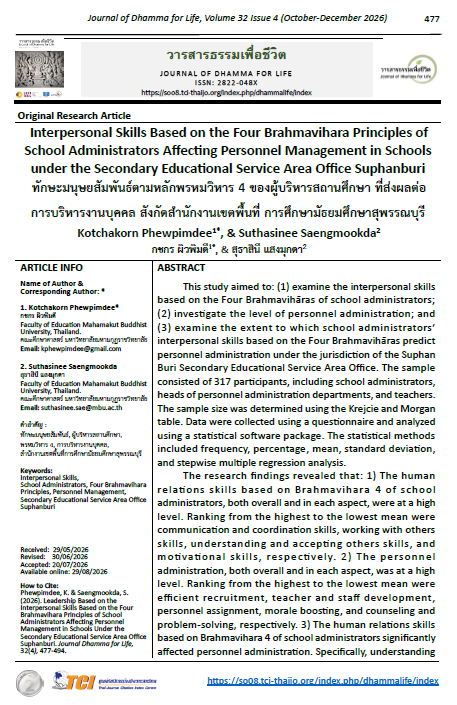
This study aimed to: (1) examine the interpersonal skills based on the Four Brahmavihāras of school administrators; (2) investigate the level of personnel administration; and (3) examine the extent to which school administrators’ interpersonal skills based on the Four Brahmavihāras predict personnel administration under the jurisdiction of the Suphan Buri Secondary Educational Service Area Office. The sample consisted of 317 participants, including school administrators, heads of personnel administration departments, and teachers. The sample size was determined using the Krejcie and Morgan table. Data were collected using a questionnaire and analyzed using a statistical software package. The statistical methods included frequency, percentage, mean, standard deviation, and stepwise multiple regression analysis.
The research findings revealed that: 1) The human relations skills based on Brahmavihara 4 of school administrators, both overall and in each aspect, were at a high level. Ranking from the highest to the lowest mean were communication and coordination skills, working with others skills, understanding and accepting others skills, and motivational skills, respectively. 2) The personnel administration, both overall and in each aspect, was at a high level. Ranking from the highest to the lowest mean were efficient recruitment, teacher and staff development, personnel assignment, morale boosting, and counseling and problem-solving, respectively. 3) The human relations skills based on Brahmavihara 4 of school administrators significantly affected personnel administration. Specifically, understanding and accepting others skills, communication and coordination skills, and motivational skills had a positive effect, whereas working with others skills had a negative effect. Together, these four variables could predict the personnel administration at 76.2% The forecast equations derived from the analysis were as follows:
In raw score form
𝑌 ′ = .582 + .516(X4) + .356(X2) + .145(X1) - .166(X3)
In standard score form
𝑍’ = .547(Z4) + .395(Z2) + .144(Z1) -.165(Z3)
Article Details
References
กระทรวงศึกษาธิการ. (2546). พระราชบัญญัติการศึกษาแห่งชาติ พ.ศ. 2542 และที่แก้ไขเพิ่มเติม (ฉบับที่ 2) พ.ศ. 2545. พริกหวานกราฟฟิค.
กระทรวงศึกษาธิการ. (2552). แนวทางการปฏิรูปการศึกษาของกระทรวงศึกษาธิการ. คุรุสภาลาดพร้าว.
กฤษณะ ภุมมา. (2568). การบริหารงานบุคคลในสถานศึกษาที่ส่งผลต่อคุณภาพผู้เรียน สังกัด สำนักงานเขตพื้นที่การศึกษามัธยมศึกษาสุพรรณบุรี. วิทยานิพนธ์ปริญญามหาบัณฑิต. มหาวิทยาลัยมหามกุฏราชวิทยาลัย.
จุนจิตร ธุวสุจิเรข. (2556). พฤติกรรมองค์การ (พิมพ์ครั้งที่ 4). คณะวิทยาการจัดการ มหาวิทยาลัยราชภัฏสวนดุสิต.
จุรี วรรณาเจริญกุล. (2558). จิตวิทยาอุตสาหกรรมและองค์การ. สำนักพิมพ์มหาวิทยาลัย เกษตรศาสตร์.
ฐิติมา ระสอน. (2564). การบริหารงานบุคคลของผู้บริหารสถานศึกษายุคดิจิทัล. วารสารนวัตกรรมการบริหารและการจัดการ, 9(2), 45-56.
ธนาชัย สุขวนิช และ พรชัย อรัณยกานนท์. (2557). การทำงานเป็นทีมและการแก้ปัญหาในองค์กรยุคใหม่. โอเดียนสโตร์.
ณัฐพล หงษ์คำ และ มีนมาส พรานป่า. (2565). ความสัมพันธ์ระหว่างทักษะการบริหารของผู้บริหารสถานศึกษากับแรงจูงใจในการปฏิบัติงานของครูสังกัดสำนักงานเขตพื้นที่การศึกษามัธยมศึกษากรุงเทพมหานคร เขต 1 กลุ่มโรงเรียนที่ 2. วารสารมนุษยศาสตร์ สังคมศาสตร์ และนวัตกรรม มหาวิทยาลัยกาฬสินธุ์, 1(2), 1–16. Doi: 10.14456/hsi.2022.10
สุนทร โคตรบรรเทา. (2551). หลักการและทฤษฎีการบริหารการศึกษา. กรุงเทพฯ: ปัญญาชน.
พระธรรมปิฎก (ป. อ. ปยุตฺโต). (2542). ภาวะผู้นำ: ความสำคัญต่อการพัฒนาคน พัฒนาชาติ. ธรรมสภา.
พระพรหมคุณาภรณ์ (ป. อ. ปยุตฺโต). (2551). พจนานุกรมพุทธศาสตร์ ฉบับประมวลธรรม. กรุงเทพฯ: สำนักพิมพ์ผลิธัมม์.
พระมหาสุรศักดิ์ สุรภาโณ (ดลรักษ์). (2556). การประยุกต์ใช้หลักพรหมวิหาร 4 ในการบริหารสถานศึกษาขั้นพื้นฐาน อำเภอเมือง จังหวัดสุพรรณบุรี. วิทยานิพนธ์ปริญญามหาบัณฑิต. มหาวิทยาลัยมหาจุฬาลงกรณราชวิทยาลัย.
ยิงยศ พละเลิศ. (2550). ทักษะมนุษยสัมพันธ์ของผู้บริหารสถานศึกษาที่ส่งผลต่อบรรยากาศองค์การในโรงเรียน.วิทยานิพนธ์ปริญญามหาบัณฑิต. มหาวิทยาลัยราชภัฏมหาสารคาม.
วิโรจน์ สารรัตนะ. (2557). การบริหารจัดการศึกษา: แนวคิด ทฤษฎี และประเด็นเพื่อการพัฒนา (พิมพ์ครั้งที่ 3). ทิพยวิสุทธิ์.
Katz, R. L. (1995). Skills of an effective administrator. Harvard Business Review.
Sergiovanni, T. J. (1981). Supervision: Human perspectives. McGraw-Hill.
Stogdill, R. M. (1974). Handbook of leadership: A survey of theory and research. Free Press.
