
Social Media for Enhancing Communication Quality of Life Elderly at Phlapphla Chai Subdistrict Elderly School, Suphanburi Province
Article Sidebar
Main Article Content
Abstract
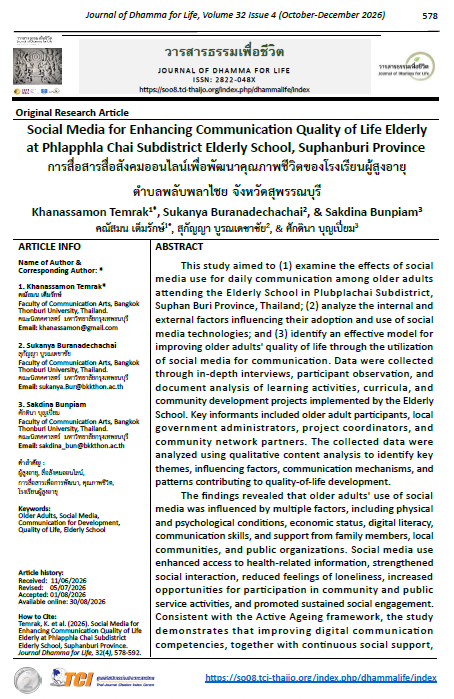
This study aimed to (1) examine the effects of social media use for daily communication among older adults attending the Elderly School in Plubplachai Subdistrict, Suphan Buri Province, Thailand; (2) analyze the internal and external factors influencing their adoption and use of social media technologies; and (3) identify an effective model for improving older adults' quality of life through the utilization of social media for communication. Data were collected through in-depth interviews, participant observation, and document analysis of learning activities, curricula, and community development projects implemented by the Elderly School. Key informants included older adult participants, local government administrators, project coordinators, and community network partners. The collected data were analyzed using qualitative content analysis to identify key themes, influencing factors, communication mechanisms, and patterns contributing to quality-of-life development.
The findings revealed that older adults' use of social media was influenced by multiple factors, including physical and psychological conditions, economic status, digital literacy, communication skills, and support from family members, local communities, and public organizations. Social media use enhanced access to health-related information, strengthened social interaction, reduced feelings of loneliness, increased opportunities for participation in community and public service activities, and promoted sustained social engagement. Consistent with the Active Ageing framework, the study demonstrates that improving digital communication competencies, together with continuous social support, enhances older adults' physical, psychological, and social well-being while fostering self-efficacy and active citizenship. Furthermore, social media serves as a mechanism for reducing the intergenerational digital divide, facilitating knowledge exchange, and empowering older adults to participate more actively in community life. These findings provide practical implications for designing policies, educational programs, and community-based initiatives that support digital inclusion and promote sustainable quality of life among older adults in aging societies.
Article Details
References
กรมกิจการผู้สูงอายุ. (2566). สถิติผู้สูงอายุของประเทศไทย พ.ศ. 2566. กระทรวงการพัฒนาสังคมและความมั่นคงของมนุษย์.
กรมกิจการผู้สูงอายุ. (2567). แผนปฏิบัติการด้านผู้สูงอายุ ระยะที่ 3 (พ.ศ. 2566–2580). กระทรวงการพัฒนาสังคมและความมั่นคงของมนุษย์.
ปณิสญา อธิจิตตา, & กุลทิพย์ ศาสตระรุจิ. (2563). การสื่อสารเพื่อส่งเสริมการมีส่วนร่วมของผู้สูงอายุในโรงเรียนผู้สูงอายุ. วารสารนิเทศศาสตร์และนวัตกรรม, 7(2), 45–62.
ราชกิจจานุเบกษา. (2546). พระราชบัญญัติผู้สูงอายุ พ.ศ. 2546. ราชกิจจานุเบกษา, 120(130 ก), 1–11.
สำนักงานคณะกรรมการพัฒนาเศรษฐกิจและสังคมแห่งชาติ. (2566). รายงานภาวะสังคมไทย ไตรมาส 4 และภาพรวม ปี 2565.
สำนักงานสถิติแห่งชาติ. (2564). การสำรวจประชากรสูงอายุในประเทศไทย พ.ศ. 2564.
Sirisuwan, P., Phimha, S., & Banchonhattakit, P. (2022). Influence of active ageing and health literacy on quality of life among elderly persons in northeast Thailand. Journal of Health Psychology, 81(6), 1–12. https://doi.org/10.1177/00178969221109329
United Nations. (2020). World population ageing 2020: Highlights. United Nations.
United Nations Department of Economic and Social Affairs. (2023). World social report 2023: Leaving no one behind in an ageing world. United Nations.
World Health Organization. (2002). Active ageing: A policy framework. World Health Organization.
World Health Organization. (2015). World report on ageing and health. World Health Organization.
Wongsala, M., Anbäcken, E. M., & Rosendahl, S. (2021). Active ageing perspectives among older adults in Thailand: A qualitative study. International Journal of Environmental Research and Public Health, 18(15), 7973. https://doi.org/10.3390/ijerph18157973
