Promoting the Well-being of the Elderly in the Elderly Club, Min Buri District,Bangkok Through the Principles of Sappāya
Article Sidebar
Main Article Content
Abstract
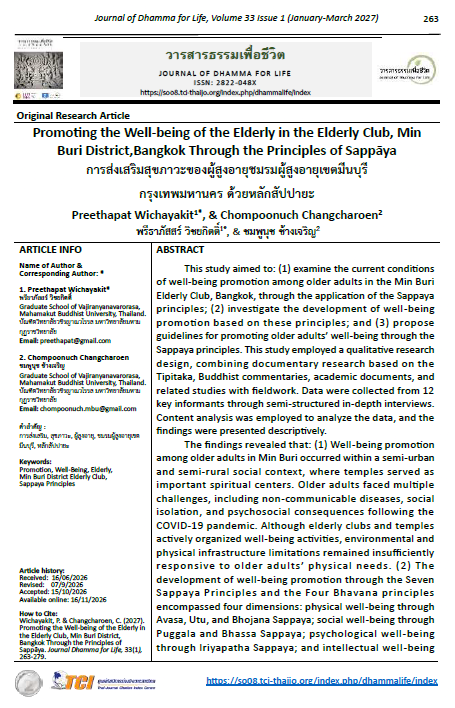
This study aimed to: (1) examine the current conditions of well-being promotion among older adults in the Min Buri Elderly Club, Bangkok, through the application of the Sappaya principles; (2) investigate the development of well-being promotion based on these principles; and (3) propose guidelines for promoting older adults’ well-being through the Sappaya principles. This study employed a qualitative research design, combining documentary research based on the Tipitaka, Buddhist commentaries, academic documents, and related studies with fieldwork. Data were collected from 12 key informants through semi-structured in-depth interviews. Content analysis was employed to analyze the data, and the findings were presented descriptively.
The findings revealed that: (1) Well-being promotion among older adults in Min Buri occurred within a semi-urban and semi-rural social context, where temples served as important spiritual centers. Older adults faced multiple challenges, including non-communicable diseases, social isolation, and psychosocial consequences following the COVID-19 pandemic. Although elderly clubs and temples actively organized well-being activities, environmental and physical infrastructure limitations remained insufficiently responsive to older adults’ physical needs. (2) The development of well-being promotion through the Seven Sappaya Principles and the Four Bhavana principles encompassed four dimensions: physical well-being through Avasa, Utu, and Bhojana Sappaya; social well-being through Puggala and Bhassa Sappaya; psychological well-being through Iriyapatha Sappaya; and intellectual well-being through Buddhist-integrated activities. (3) The study proposed the Sappaya–Bhavana–Chara Model (SBC Model), comprising three interconnected levels: physical infrastructure and policy, group processes and social behaviors, and spiritual wisdom and the meaning of life. This integrated model provides a framework for enabling older adults to accept life changes in accordance with the principles of Jarasutta and Tilakkhana, thereby supporting peaceful and meaningful aging while preserving human dignity and promoting sustainable well-being.
Article Details
References
กรมกิจการผู้สูงอายุ. (2569). สถิติผู้สูงอายุประเทศไทย พ.ศ. 2569. กรุงเทพมหานคร: กระทรวงการพัฒนาสังคมและความมั่นคงของมนุษย์.
กรมอนามัย. (2567). คู่มือการส่งเสริมสุขภาพผู้สูงอายุในชุมชน. กรุงเทพมหานคร: กระทรวงสาธารณสุข.
กระทรวงสาธารณสุข. (2566). แผนปฏิบัติการด้านผู้สูงอายุแห่งชาติ ฉบับปรับปรุง. กรุงเทพมหานคร: กระทรวงสาธารณสุข.
คณะกรรมการสุขภาพแห่งชาติ. (2550). พระราชบัญญัติสุขภาพแห่งชาติ พ.ศ. 2550. กรุงเทพมหานคร: สำนักงานคณะกรรมการสุขภาพแห่งชาติ.
ธัญรัศม์ ภุชงค์ชัย. (2567). การศึกษาระดับสุขภาวะแบบองค์รวมและคุณภาพชีวิตของผู้สูงอายุ อำเภอเมือง จังหวัดชัยภูมิ. วารสารศูนย์อนามัยที่ 9.
ป.อ. ปยุตฺโต (สมเด็จพระพุทธโฆษาจารย์). (2562). สุขภาวะองค์รวมแนวพุทธ. กรุงเทพมหานคร: มูลนิธิพุทธธรรม.
ป.อ. ปยุตฺโต (สมเด็จพระพุทธโฆษาจารย์). (2564). พุทธธรรม ฉบับปรับขยาย. กรุงเทพมหานคร: ผลิธัมม์.
พระครูอุดมฐิติคุณ (อิทธิพล อนุตฺตโร/จำปาศรี), อภินันท์ จันตะนี, และสมเดช นามเกตุ. (2568). การส่งเสริมสุขภาวะของผู้สูงอายุโดยใช้หลักพุทธธรรมทางพระพุทธศาสนาในจังหวัดหนองคาย. วารสารปัญญาปณิธาน, 10(1).
ภมรพรรณ ยุระยาตร์. (2555). สุขภาวะของผู้สูงอายุตามแนวคิดของไรฟ์. วารสารพฤฒาวิทยา, 12(2), 45–61.
มหามกุฏราชวิทยาลัย. (2563). หลักพุทธธรรมเพื่อการพัฒนาคุณภาพชีวิต. นครปฐม: มหามกุฏราชวิทยาลัย.
สำนักงานสถิติแห่งชาติ. (2568). การสำรวจประชากรสูงอายุในประเทศไทย พ.ศ. 2568. กรุงเทพมหานคร: กระทรวงดิจิทัลเพื่อเศรษฐกิจและสังคม.
Adams, T., Bezner, J., & Steinhardt, M. (1997). The Conceptualization and Measurement of Perceived Wellness. American Journal of Health Promotion, 11(3), 208–218.
Pender, N. J. (2011). Health Promotion in Nursing Practice (6th ed.). Boston, MA: Pearson Education.
Ryff, C. D. (1989). Happiness Is Everything, or Is It? Explorations on the Meaning of Psychological Well-Being. Journal of Personality and Social Psychology, 57(6), 1069–1081.
United Nations. (2024). World Population Prospects 2024. New York, NY: United Nations.
World Health Organization. (2023). Decade of Healthy Ageing 2021–2030. Geneva: World Health Organization.
World Health Organization. (2024). Ageing and Health. Geneva: World Health Organization.